Passage Notes, Ireland bound.
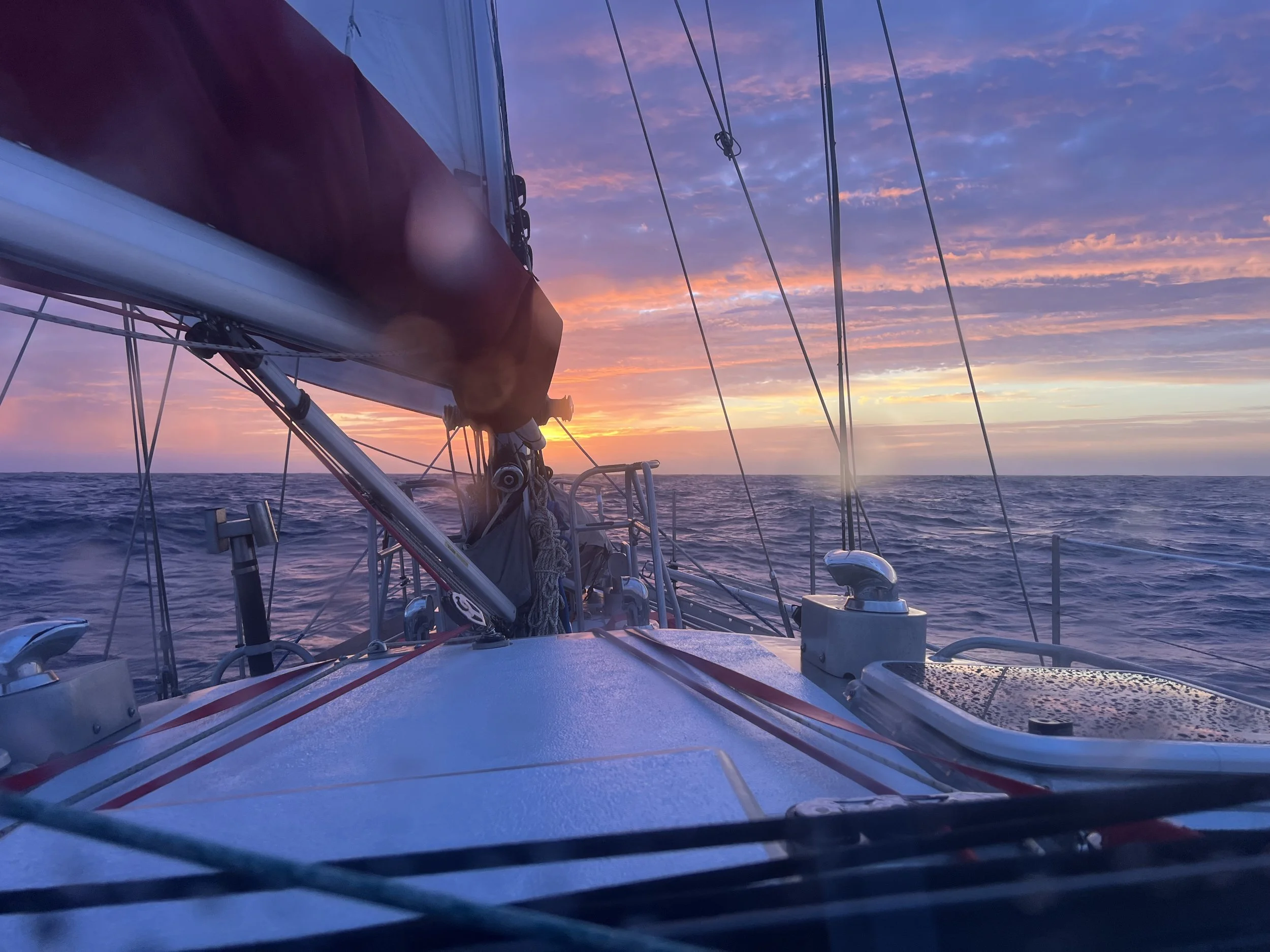
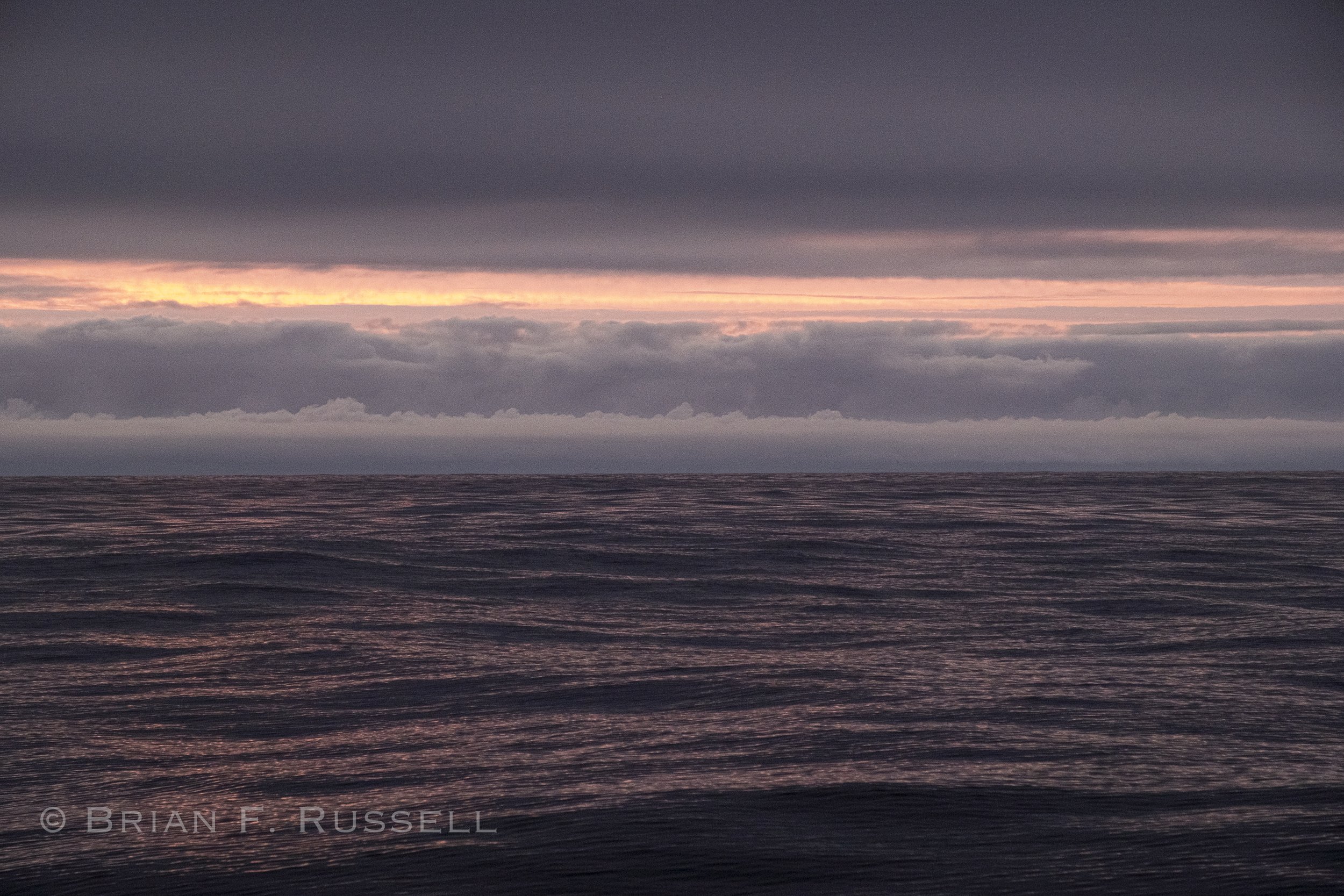
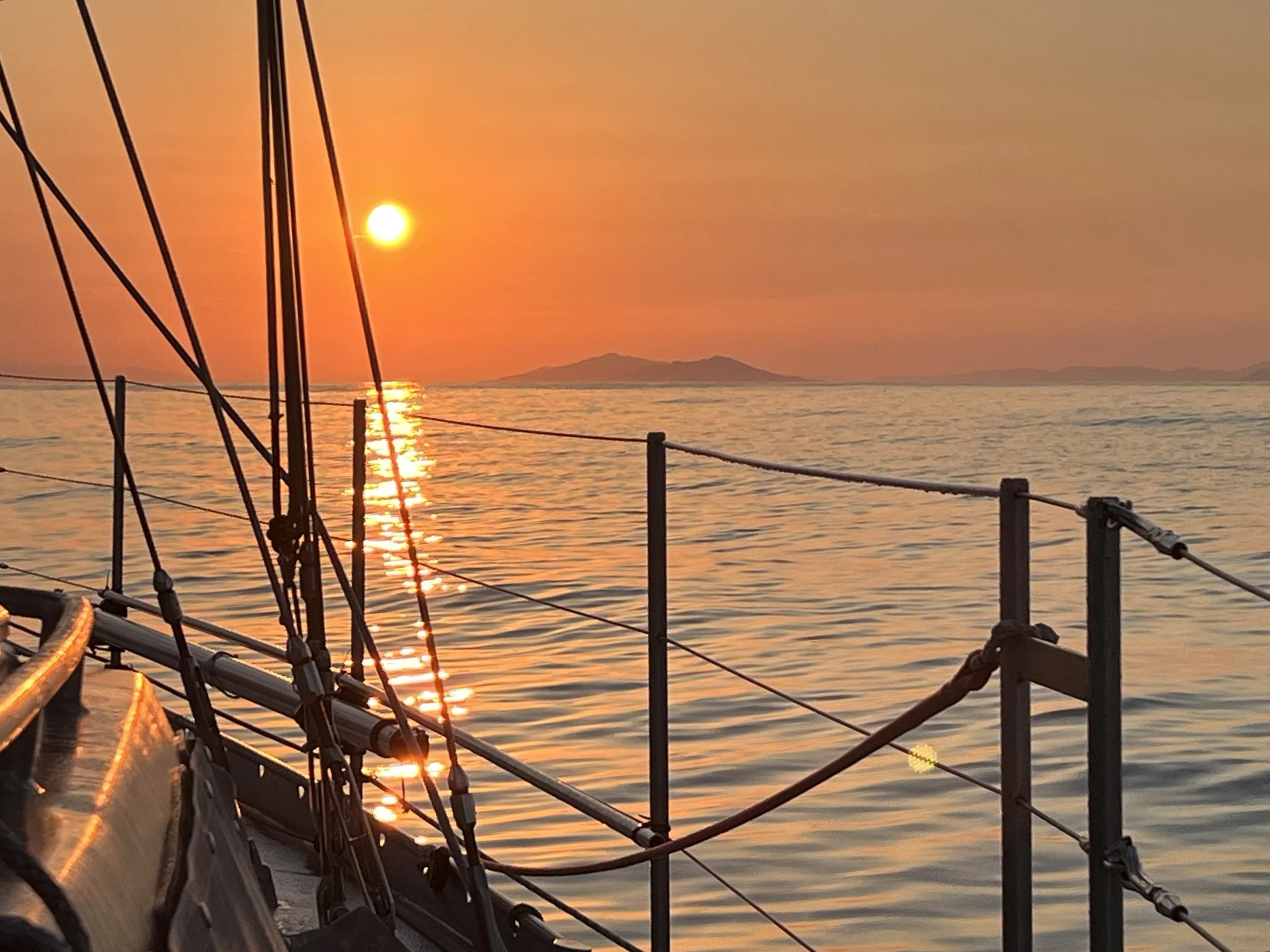
Sunrise on passage, heading east.
June 24 2026, Armdale Yacht Club Marina, Halifax Nova Scotia. 2377 nm to go.
The wind from the passing front has died, but now it is raining. A steady heavy drizzle through most of the morning. Finally it eases up and we put on our rain gear. The dinghy is emptied of the accumulated water and lowered off the back davits into the water. We take off the motor with our small crane and attach it to the rear rails, securing with a second line to stop it swiveling in the swell. The dinghy is then squeezed alongside into the slip and hoisted onto the front deck with a spare halyard. We secure the deflated dinghy to the cradle on the coachroof, pop the code zero sail bag into it, along with the gas tanks and seat bag. The dinghy is rachet-strapped and turn-buckled so it can’t be dislodged and covered with a Sunbrella cover to prevent it becoming inundated with water while underway. All this takes about an hour. We have a final check on the weather forecast and back out of the slip. Of course it is right at low tide, but we manage not to run aground and head out into the channel. Just as we are leaving, we see our new Dutch friends on SV Sya in their dinghy heading for shore. They swing by and we say our farewells. They will be doing a similar trip in about a week when their extra crew member arrives.
The rain has stopped completely now and the sky is beginning to clear. We enjoy the trip down the Armdale arm, past the large and very expensive homes, past the Royal yacht club and out into Halifax Bay. There are a couple of boats already making their way out to the ocean. They also waited for the rain to stop and the prospect of wind picking up before they set off. We raise the mainsail with a couple of reefs before we hit the swell, and continue to motor sail south out of the large bay.
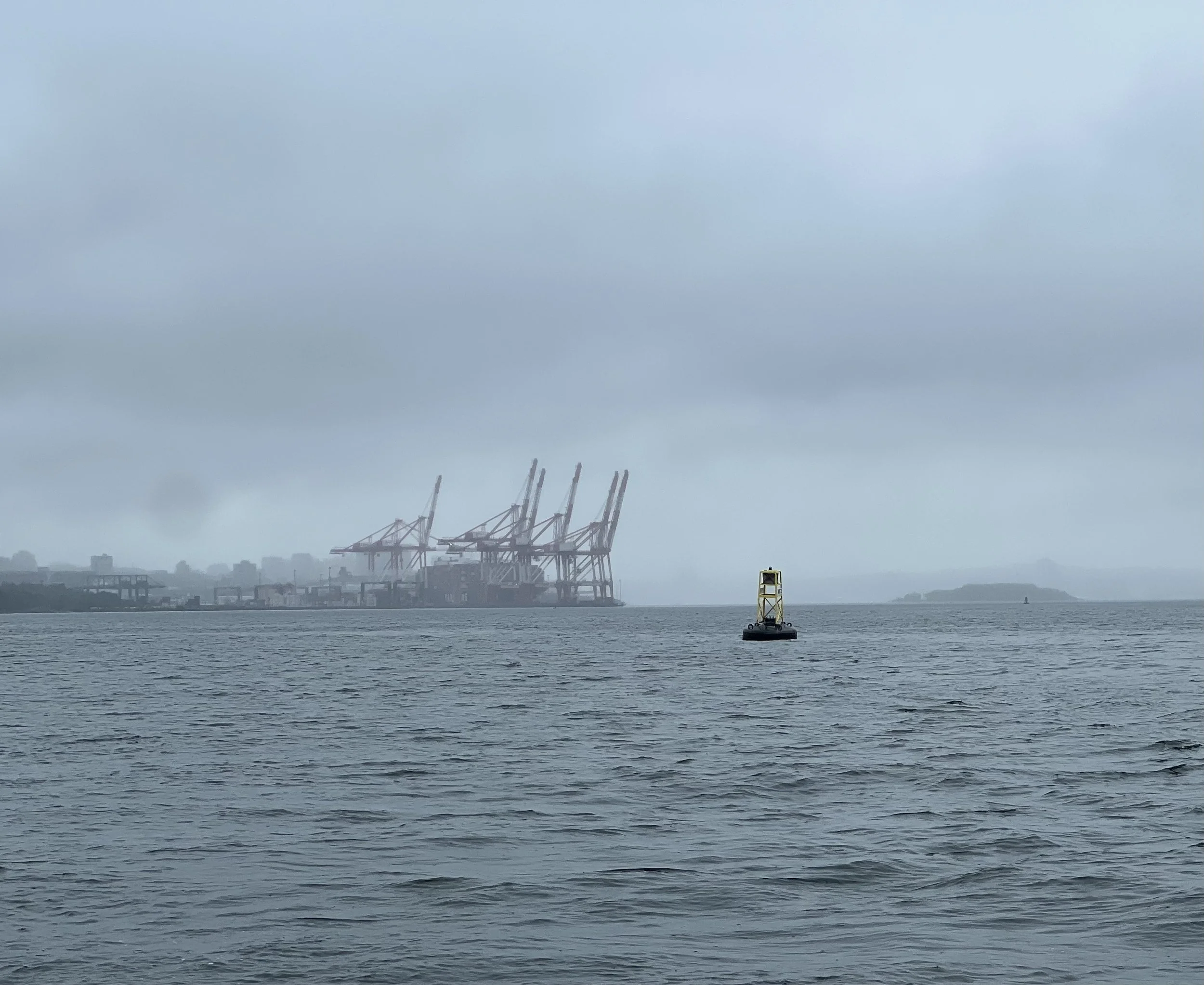
Leaving Halifax.
Day 1 June 24-25 2026. 43°02.19N 60° 56.15W, Noon to noon 157nm.
The first few days of passage are always hard. The body has to adjust to the constant motion in three directions. Fortunately, although I might feel queasy, I do not actually get sick, I just lose my appetite and have to make myself nibble on toast, fruit and crackers for a couple of days. Brian has to really fight the nausea. It is so unfair, someone who loves our aquatic lifestyle, the requirement for self sufficiency, the isolation, the challenge of interpreting the weather and navigating us safely through, has to spend the first 3 days fighting to keep from being sick. He gets very lethargic, and spends a lot of time napping, but absolutely never misses his assigned watch and does not shirk from dealing with reefing or unreefing the sails if and when it is needed.
In general on Helacious we do tend to have blue jobs and pink jobs. I know I have a much easier time of it, especially on passage. Brian is responsible for all the maintenance and boat improvements. I take care of ship’s stores, knowing where that jar of pasta sauce is stored and how many onions remain. I also do the planning, investigating the future adventures, the possible anchorages and facilities available. Apart from finding the pasta, none of my jobs are really relevent on a passage, while Brian’s side of the list take on much more importance.
In addition, on passage he is the one who goes forward on deck. He pulls the mainsail up, or reefs it. All of which has to be done at the mast. He also goes forward to put up the pole and raise the code zero (our big light air sail) when those are needed. It is scary, let’s be honest, in a boat speeding through the water, with random violent motion, to be dealing with the heavy labor of raising sails and manhandling the pole. I am always very encouraging, from the shelter of the cockpit. When we cook, either of us may be responsible for the meal, although he always cooks breakfast. He also downloads and analyzes the weather. We always discuss the latest grib (gridded binary) weather data files and what our course for the next 24-48 hours should be, but his computer is the one with the routing software, LuckGrib, on it.
All this is to say, the first days are especially tough. This first day was no exception. The engine stays on for quite a while, although there is some wind, it is only about 10kt, and insufficient to counter the rolling swell left over from the passing front. By 7pm we have the engine off, the genoa out and we are enjoying sunny skies, a perfect beam reach in 19kt of wind, heading is 123°, SE. Perfect sailing conditions, if only we felt better. The seas are quite boisterous; we have yet to find our sea legs. We change our course to head a little more south, to try and avoid forecast 10ft+ seas.
In the evening I take out some homemade chicken noodle soup for dinner. It is easy on the stomach and simple to just heat up in the rolling waves. We try to make a number of passage meals ahead of time. The practical and realistic nature of passage making is that cooking is hard. Anything, especially in that first week to make it easier on the crew is a good idea.
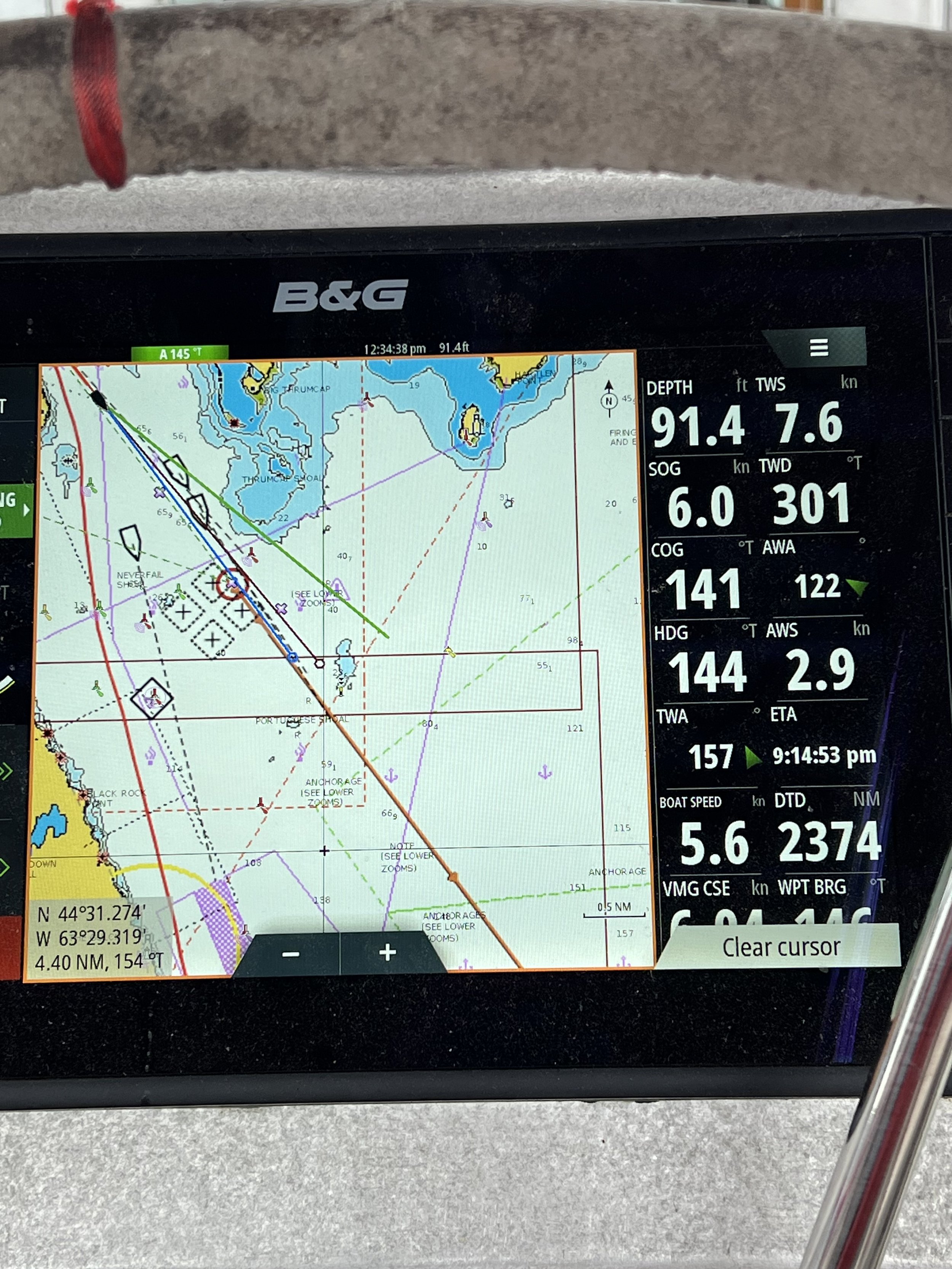
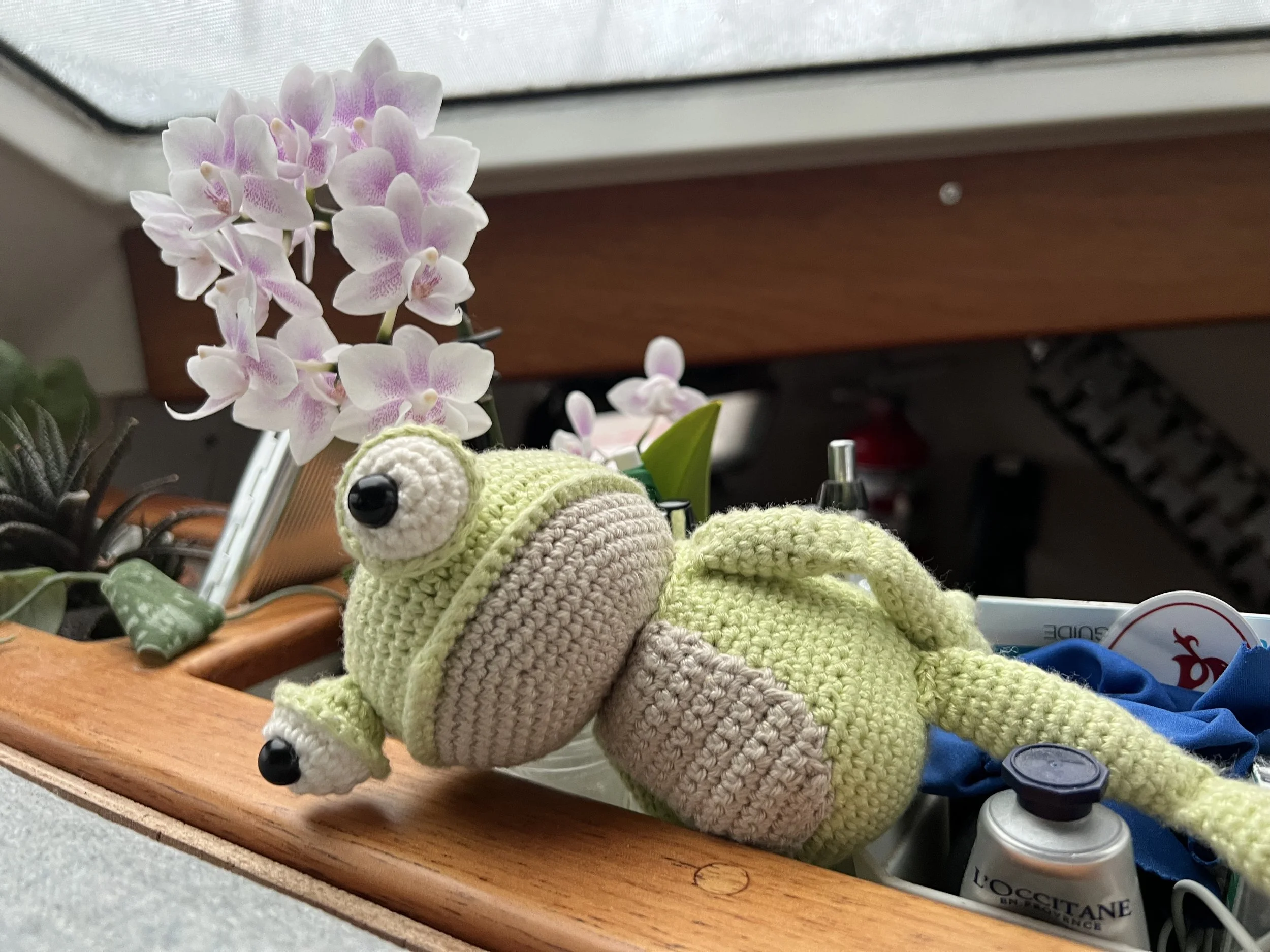
Day 2 June 25-26 2026. 41° 25.79N 57° 23.66W, noon to noon 128nm.
On the second day the wind fades, a mere 8kt is not enough to move us along, especially in ocean swell. The engine is turned on. We pull in the genoa, its slatting in the roll of the waves is painful to watch. The main, however, is left up, at the third reef. It is tightly centered to try and help calm down the rolls of the boat, and it also makes hoisting it at a later time much easier. The skies are sunny and we are visited by some small North Atlantic dolphins.
Not quite up for cooking yet, I guess it is chicken soup again.
The next morning is grey and foggy and the engine is still on. During the morning, the fog clears and the wind, which is now forward of the beam, is slowly increasing. We pull out the genoa and motorsail at AWA 45°, finally turning off the engine at noon when the wind is steady at 12kt.
Day 3 June 26-27 2026. 40° 24.72N 55° 58.21W, noon to noon 166 nm.
The gentle swell and light winds continue until midnight, then it picks up to near-gale strength. The 30kt wind are more from the west so we can sail to the SE in a broad reach which helps make it all a little less fraught. We spend some of the time in the eddies of the Gulf Stream, which are still quite significant in places. The routing software is aware of these and has us riding the currents when we can and avoiding them when it would be wind over current, which would make things far more uncomfortable. They add to our boat speed and we sail at hull speed or greater (8+kt) for quite a while. A tanker is on a collision course with us, so we hail it on the radio and ask him to alter course. They always do, some more friendly than others.
Breakfast for dinner: poached egg on avocado toast. All those avocados have ripened at the same time.
Day 4 June 27-28 2026. 39° 06.89N 53° 13.85W, noon to noon 153nm.
At noon on the beginning of the fourth day the wind disappeared, just 5-10kt for the next few hours. Of course the waves don’t just disappear too, so we motorsail, keeping the main up at third reef, to avoid the slatting and help with the roll. When the waves flatten out, we turn the engine off and sail slowly for a while. Showers pass through, some quite heavy, but not squalls. The deck gets a fresh water rinse. With the batteries fully topped up from all the motoring we do not want to run the generator to make water, we just flush the membranes instead. These regular boat maintenance jobs do not stop just because you are on a multiday passage.
We continue to head SSE. The wind returns to full strength and we make haste to try and get south of 39°N, then we can finally turn east.
We are beginning to enjoy food a little more, but it is just too rough to be dealing with actually preparing a meal. Make it easy with ravioli and marinara sauce.
Day 5 June 28-29 2026. 38° 37.22N 49° 32.44W, noon to noon 175nm
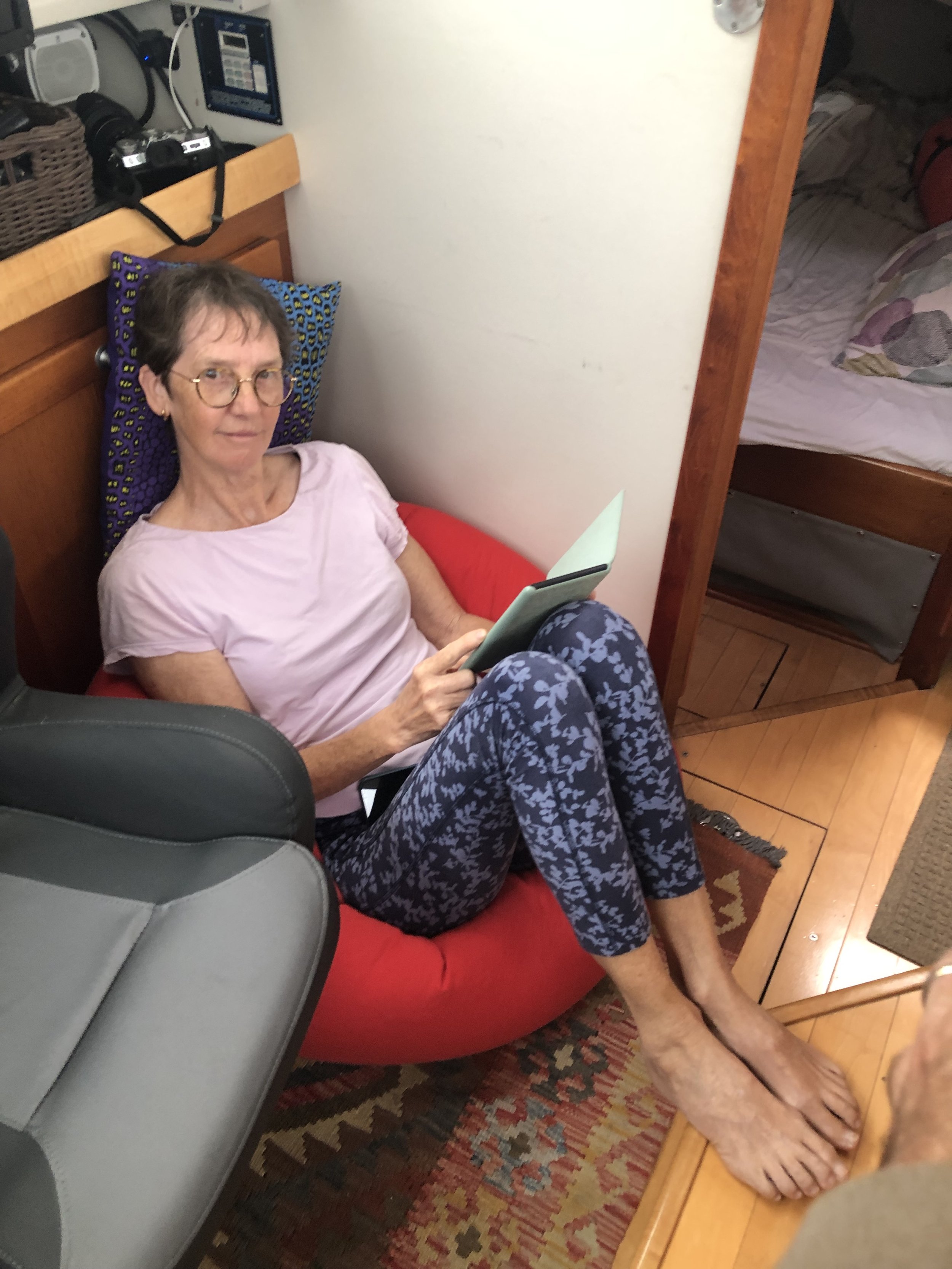
The wind is steady in the mid-20’s for the whole 24 hour period. We change our course to head in a more easterly direction finally, 105°T. Folks at home are thinking we are heading to the Azores as we have swooped so far south. That is not the plan, but we needed to do this to avoid the lows rumbling across the Atlantic to our north. We are making very fast times. Normally our 24 hour passage distances are around 120-140nm, an average of 5-6kt. It is good news, at least the detour south will not make the passage much longer. We are guessing 18 days. The downside is that it is exhausting to do ANYTHING. We are very thankful it is a starboard tack we are on, we can collapse sideways onto the seats next to the table and lean against the wall as the boat lurches along. In a port tack we slide off the seats, so we have to either sit in the quarterberth, braced in place with cushions, or sit on the floor by the Nav station on a beanbag we carry for just that purpose.
We discovered the exhaust fan on our composting toilet is not working any more. It is too rough to deal with right now, it will have to be investigated soon though. That fan needs to work!
Chicken soup, the last of it.
Day 6 June 29-30 2026. 39° 00.36N 45° 25.67W, noon to noon 195nm (Helacious record)
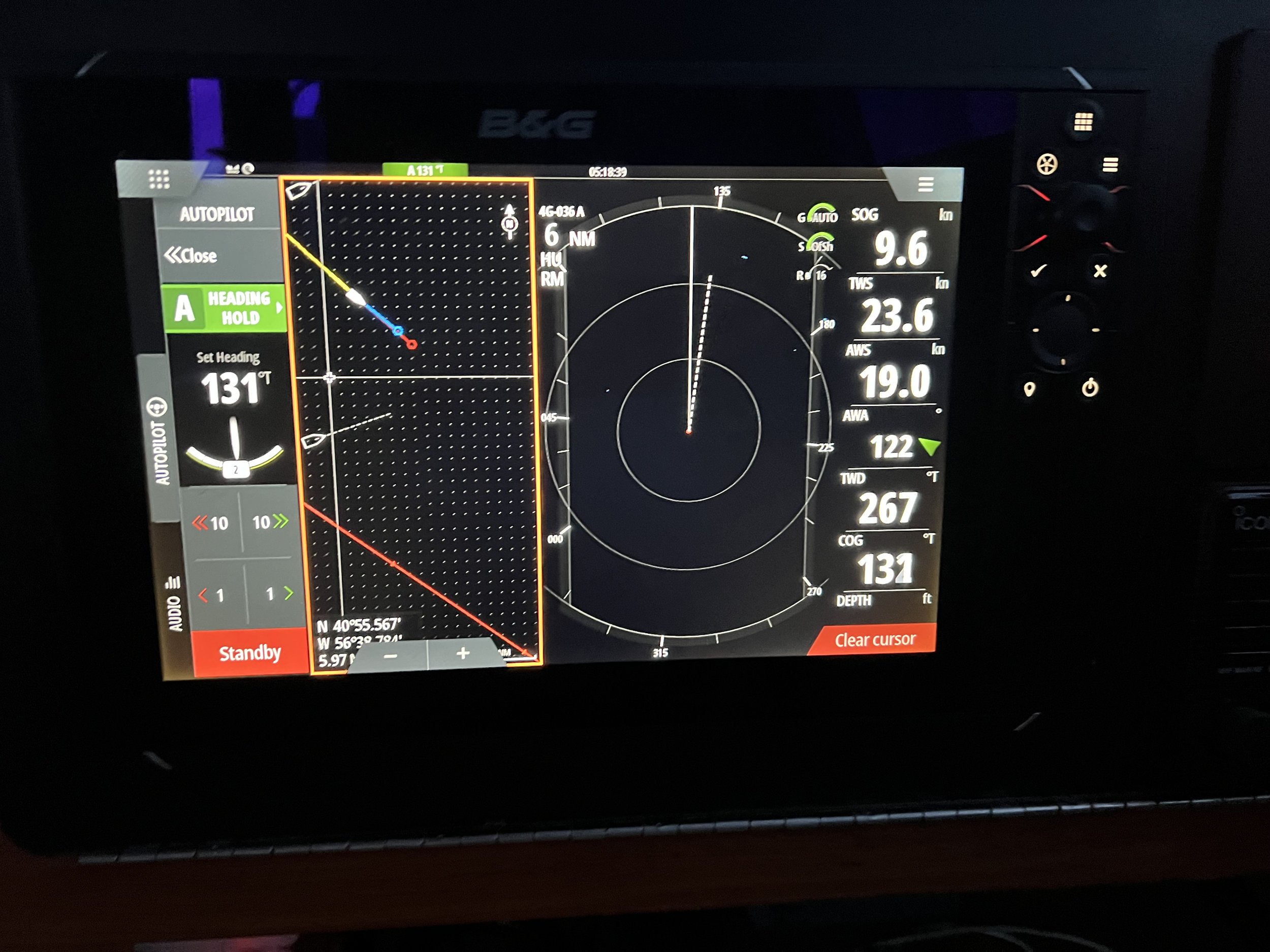
Heading east, the wind from the SW, a perfect point of sail. The winds are high and we are riding the Gulf Stream. Thank goodness the winds are aft of the beam, 12 hours of 25-30kt winds, it is a new record for a 24 hour distance. We see boat speeds up to 9.6kt. Hang on and hold fast.
Crackers cheese and pate; too rough to cook.
Day 7 June 30-July 1 2026. 39° 48.67N 42° 23.40W, noon to noon 152nm
At 0630 we are passed by CV-30, a Clipper Round the World raceboat. They were sailing from Washington, DC to Oban, Scotland, and came quite close, sufficient for good photos, before they sped away at 11 knots. We chatted briefly on the radio. The first mate, who sailed on every leg of the race, did admit she was a little envious of our creature comforts onboard Helacious. The price for speed is 18 crew, probably hot bunking it, and minimal amenities onboard. From visiting the Clipper boats in Oban a few years ago, we know they are all hand steered, no autopilot, and with hank-on sails. You know those have to be really heavy for a 68ft boat. The on-watch crew were all in their foulies on the deck, while I took the photos in my shorts and dry T shirt from behind the cockpit enclosure panels, well rested, dry and not windblown. Having said that, with all their sails up, they were flying along at over 11 kt, and will be in Scotland in 8 days, while we face another 11 days of passage.
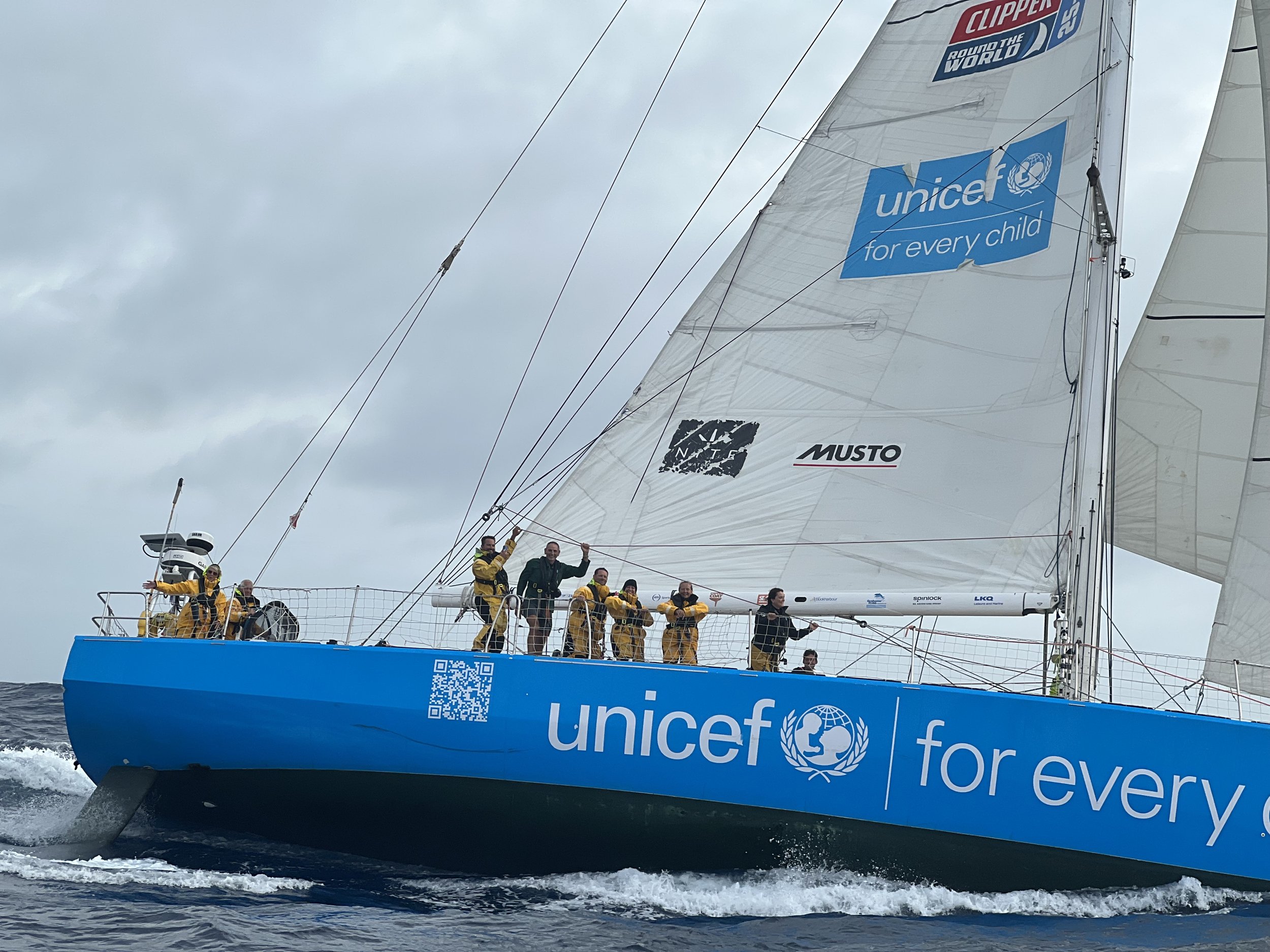
The Clipper raceboat thunders past.
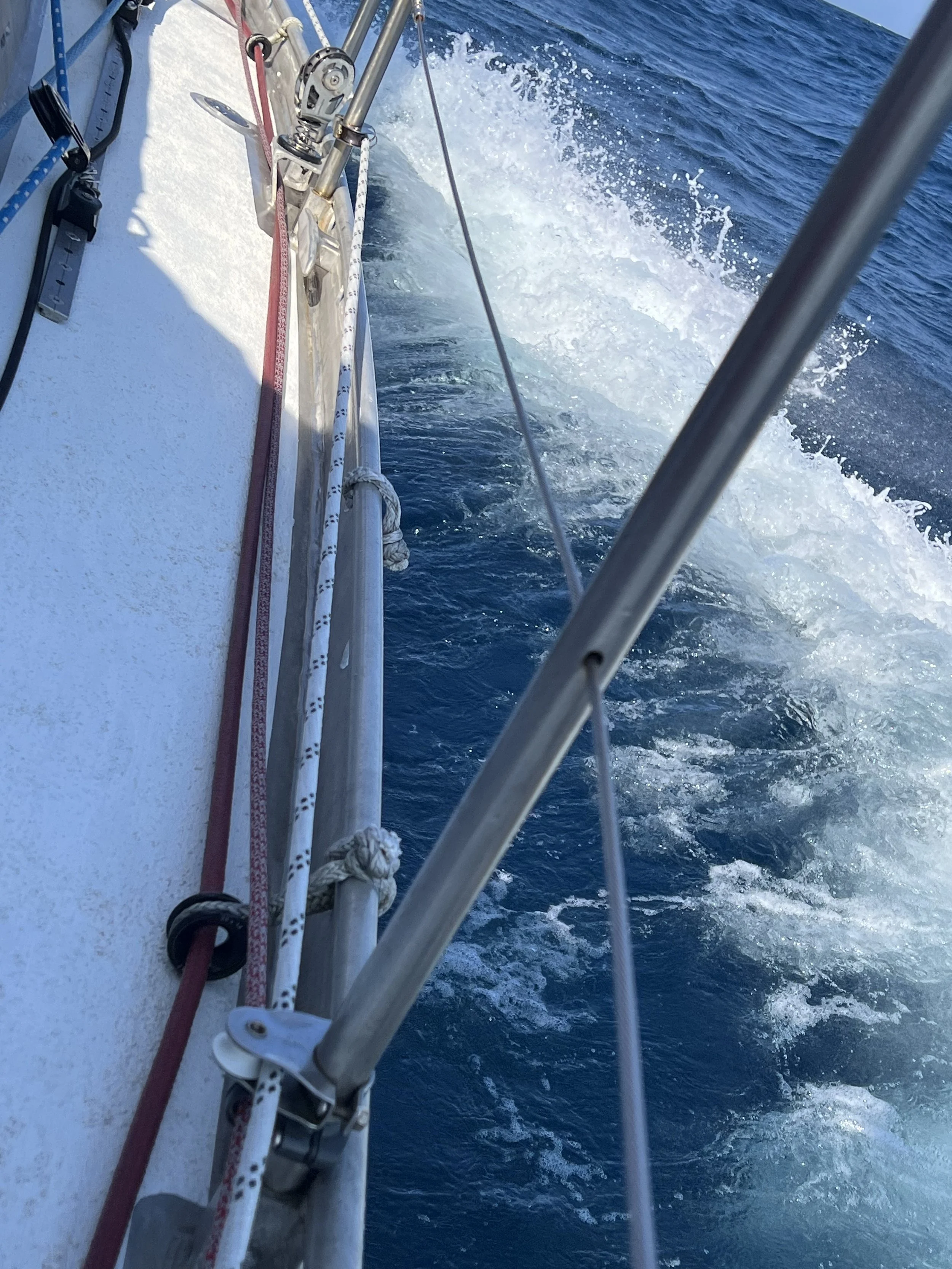
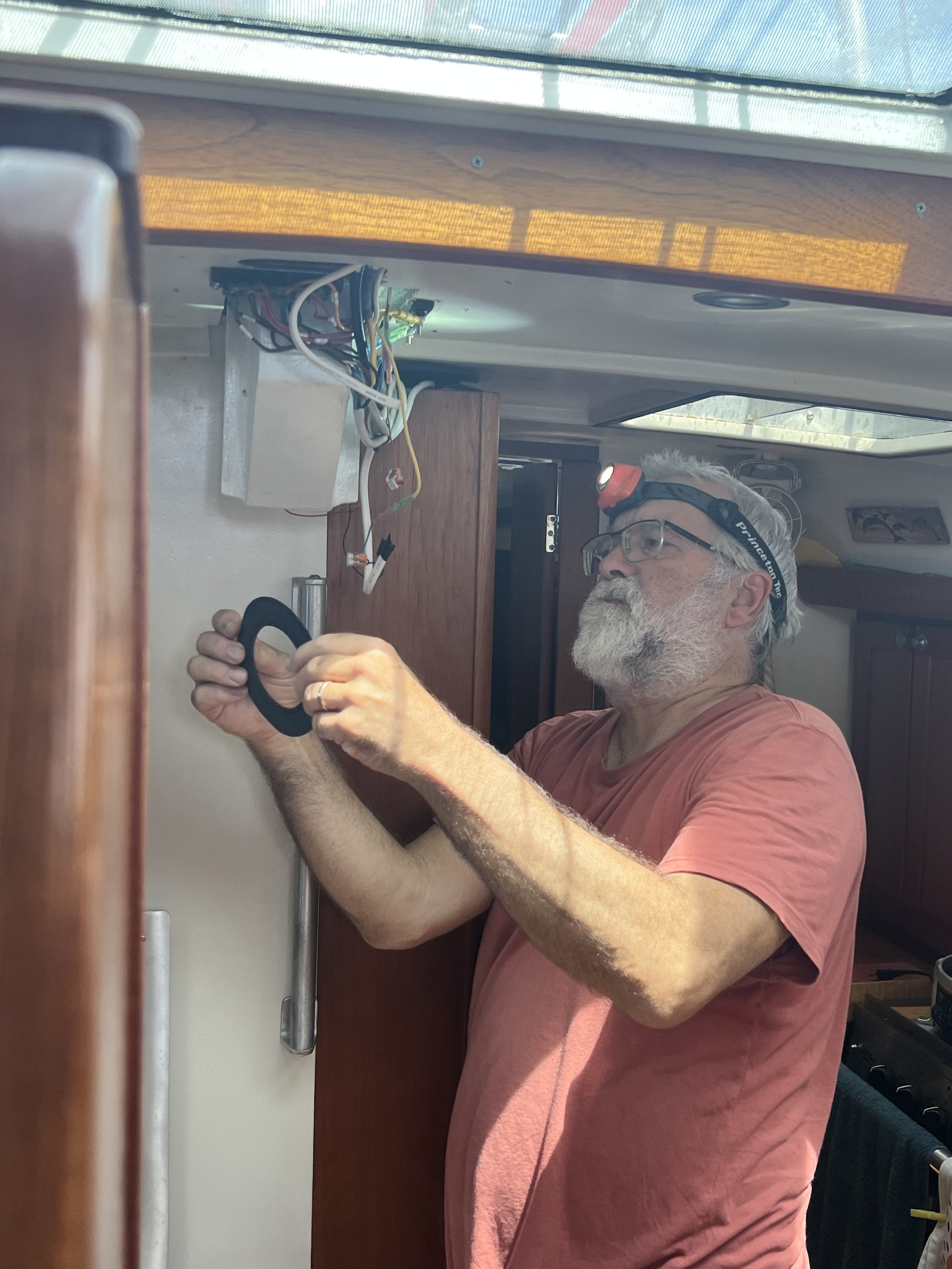
Brian fixed the toilet fan by replacing it with a spare from under the quaterberth bunk. The seas were comparatively calmer today, although we are still sailing fast with an average speed of about 6.5kt, but it allowed us to dismantle the bed to get access to one of the spares bins stored under there. We really should just put a spare fan in an easy to access location, passages are hard on the composting toilet. Under normal circumstances it works great for 2 people, especially in warmer climates. However it relies on a fan pulling air through and venting it just aft of the mast base. With all the green water coming over the deck ( not to mention the whole pilot house!) this last couple of days, it is hardly surprising that some found its way down to disable the fan.
Shepherds pie from the freezer.
Day 8 July 1-2 2026. 41° 27.35N 39° 36.63W, noon to noon 164nm
Steady winds in the low 20’s all night, we sail with 2 reefs in the main and two in the genoa. We shake out the second reef after daylight, somehow it is easier to stand the fast pace in daylight. It all depends on the angle of the wind. If it is little aft of the beam, the waves are too, and we can carry more sail. In the morning the generator is fired up for an hour to make water. We make enough so in four days we will just need to flush to keep the membranes in tip top condition.
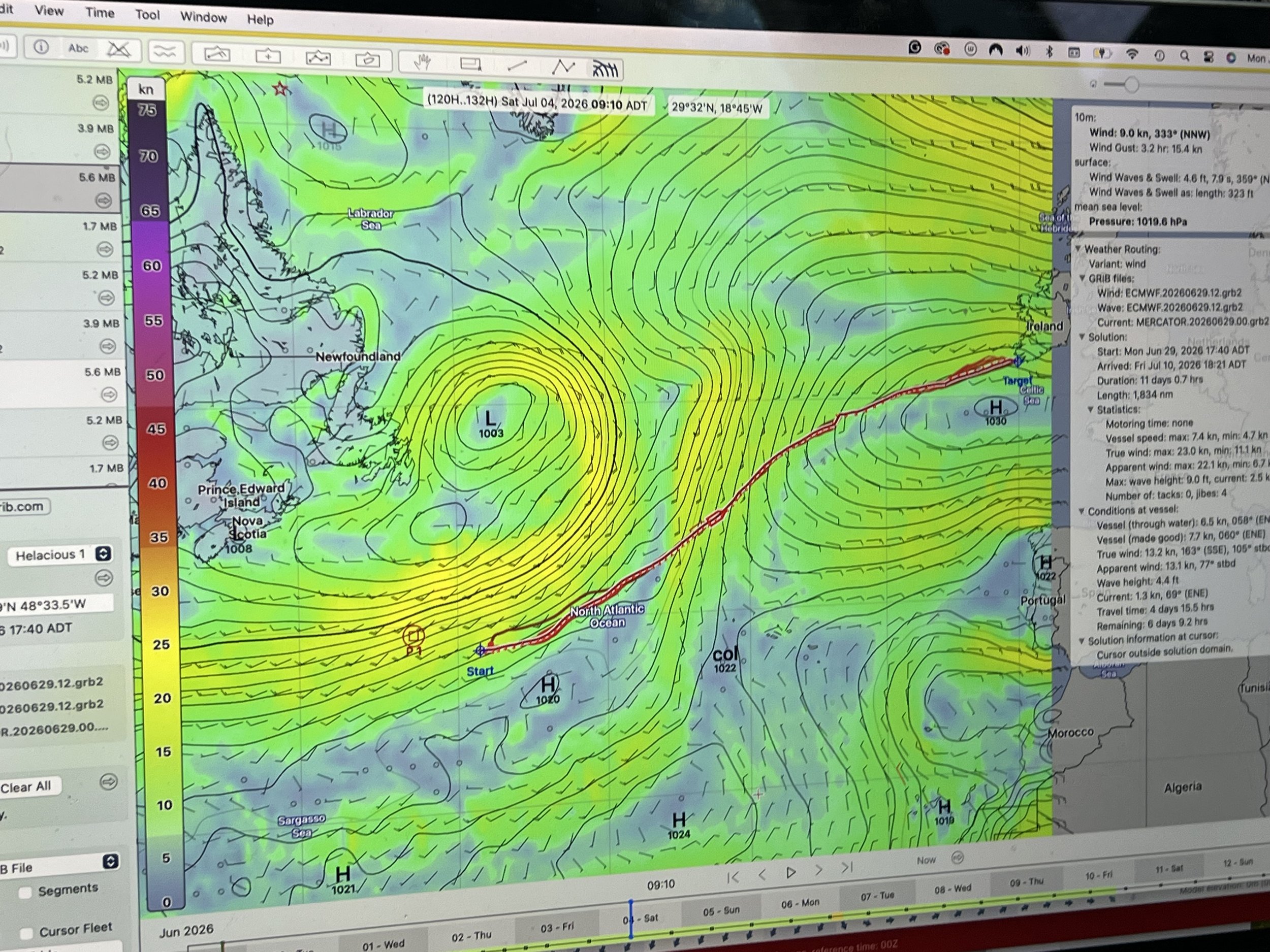
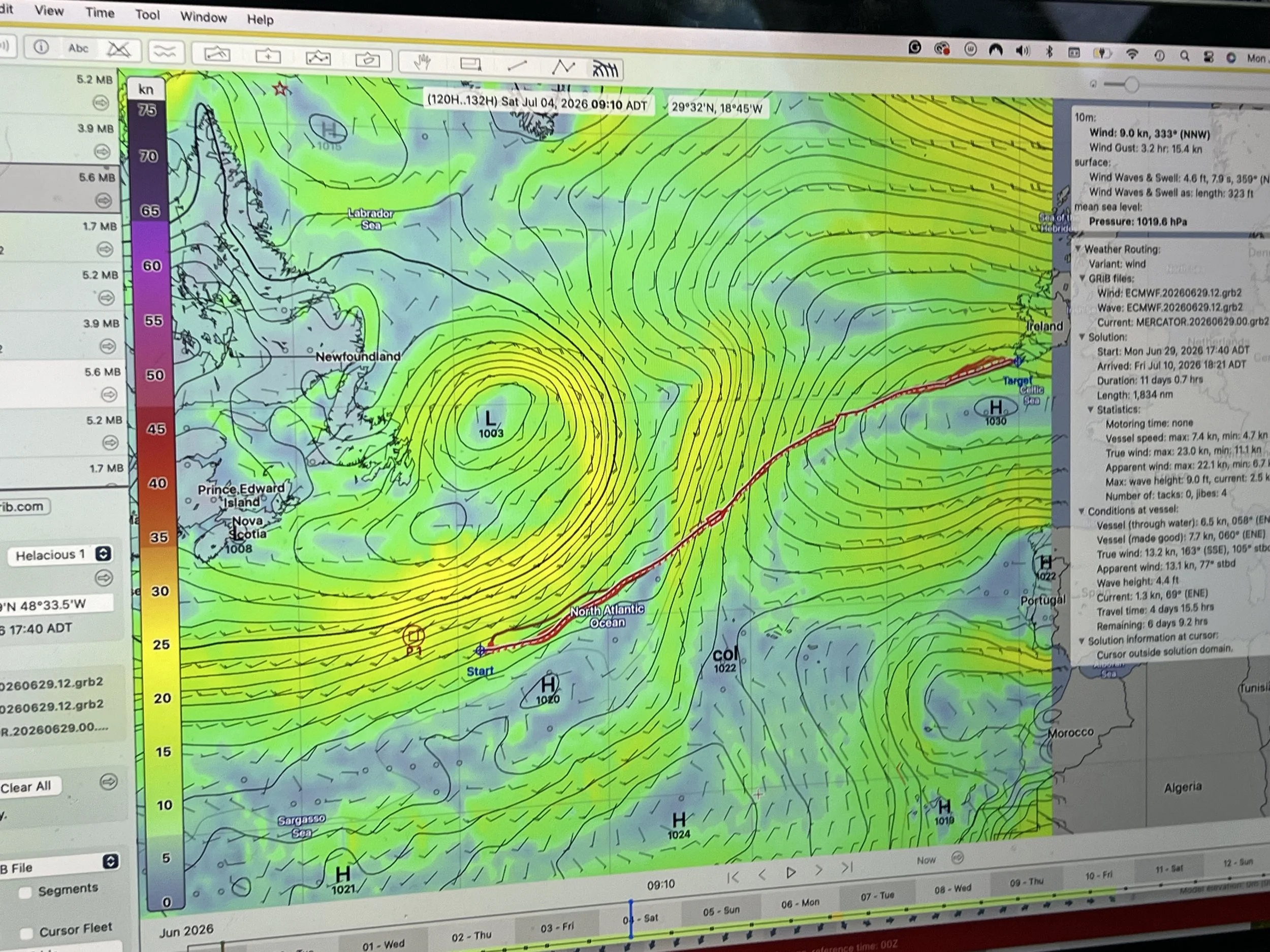
We have a choice to make on the route. The LuckGrib software gives us two alternate routes over the next 3 days. As a front passes by we can either stay on the more easterly course, 62°T, keeping us in good wind initially until midday Friday, but then as it weakens and the band of wind narrows, being sure we will stay in that wind is tricky. If the band chooses to shift to the east or west, we will be in very light winds and motoring for at least a day before it fills in again from the west. The alternative is to head more NNE, on a course of 30°T, this has us skirting along the edge of a low, staying in winds in the mid 20’s. At around midnight there would be a strong wind shift as a line of thunderstorms and squalls passes, and then the wind will disappear and we would be left with the large waves for hours, until the wind fills in from the west. We have had a similar situation in a previous transatlantic passage, also at night. It was not much fun, racing along in the rough seas, wondering where the front is, the complete darkness of the night precludes being able to see the clouds and rain squalls on the horizon. The worry that the sudden wind shift would gybe or broach the boat. We managed all that previously, but the worst part was the way the line of thunderstorms sucks the energy out of the air, the wind dies completely and you are left with the lumpy seas with no wind. We gambled that our weather forecasts are fairly accurate. They have been spot on so far on this trip, estimating our boat speed and where we would be in the next 12-24 hours quite well. We will trust that to keep us in the sailable but light winds, rather than choosing to head into thunderstorms and lightning at night. The routing software has us arriving at the same point at the same time in three day’s time, so there is nothing to be gained by putting us through a more stressful ride.
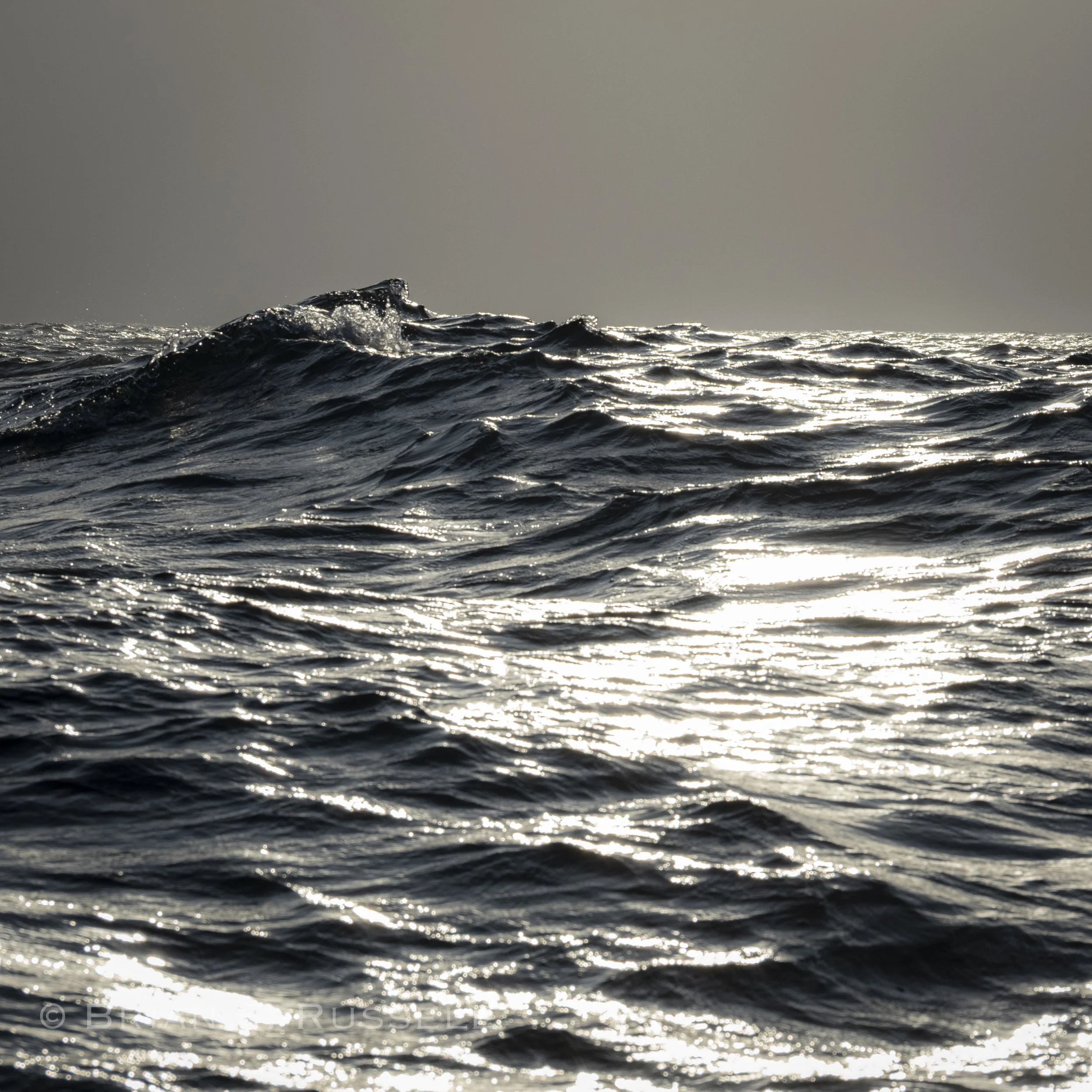
The wind increases during the day and we bear off a little to try and keep the motion more comfortable. The waves have to be 12 foot or more, after all we have had strong steady winds for days now. We get green water not only over the foredeck, but occasionally over the pilot house and also breaking under the enclosure into the cockpit. As it is now quite a bit warmer, Brian cracks the hatch over the table for a little fresh air. Yes, you guessed it. A gallon of salty water rushes down onto the table and splashes the computer and ipad. He is in the doghouse for a while. Electronics survive.
Chili and saltine crackers for dinner.
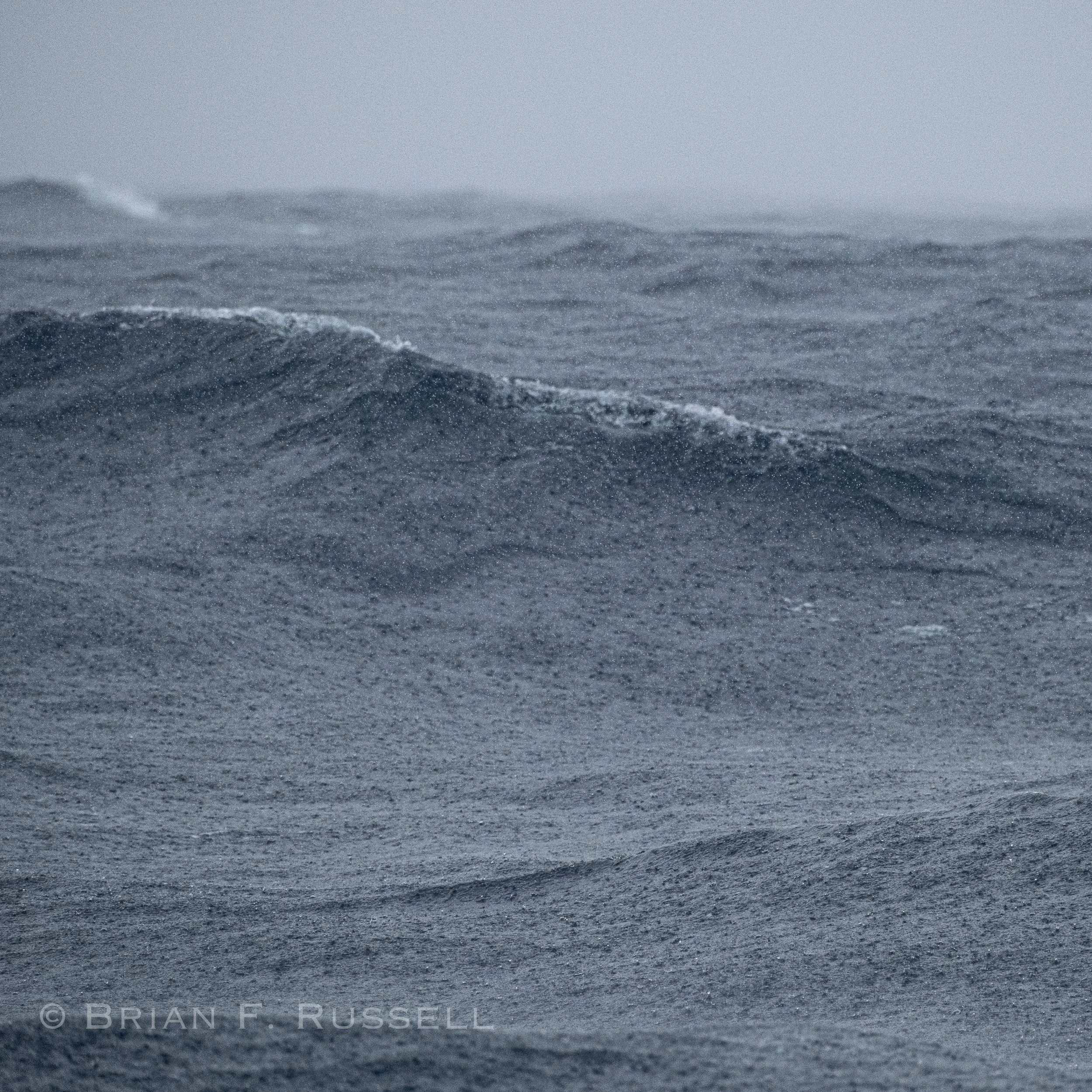
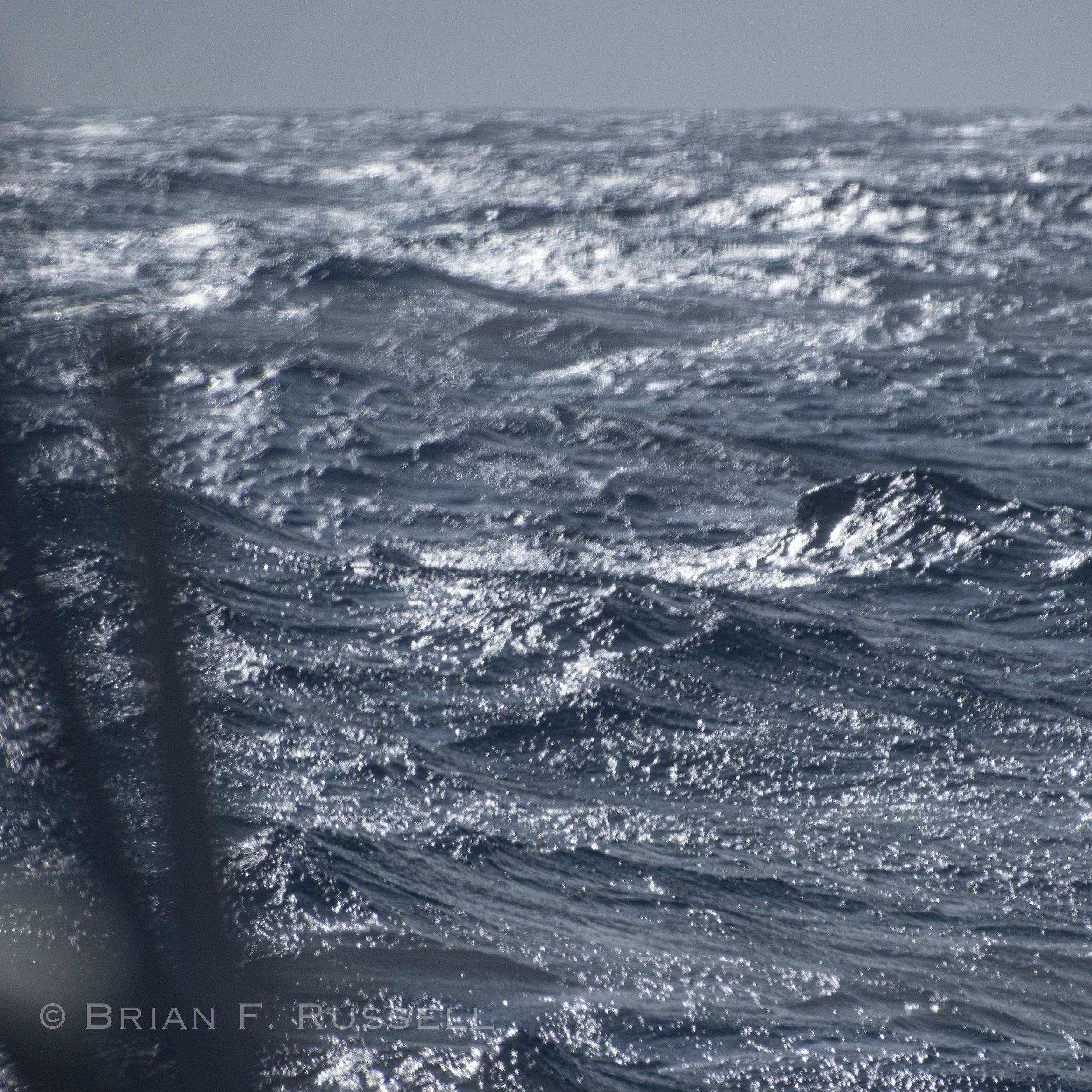
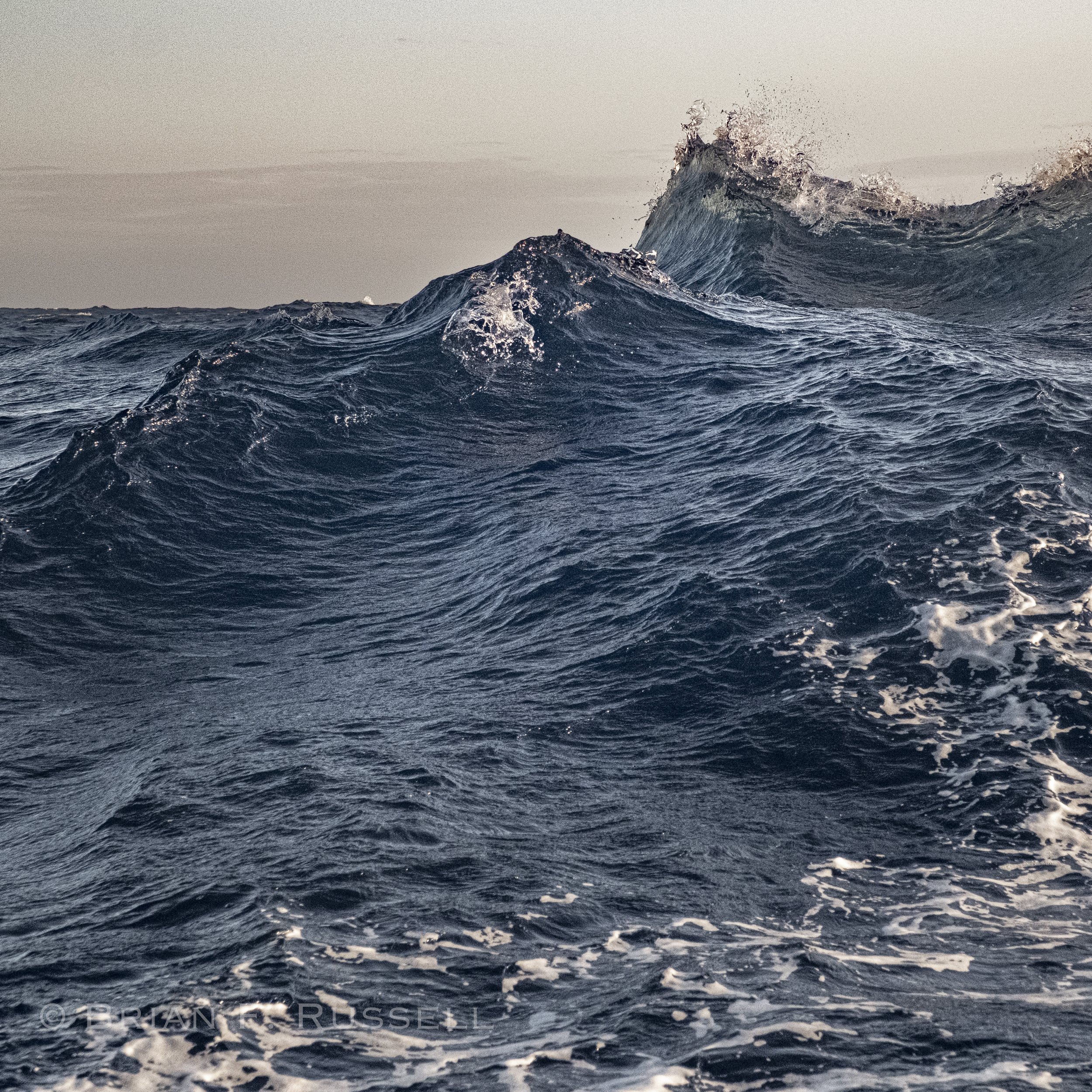
Day 9 July 2-3 2026. 42° 57.23N 36° 07.65W, noon to noon 178nm
In the afternoon we log into the Starlink and the NoForeignLand notification pops up. A Dutch sailboat was passing 10nm away, no visual, heading to Newfoundland. They saw our AIS signal, but we were too far maybe for radio contact. We chatted a little back and forth then turned the satellite off again. Starlink is a game changer for these long passages, the ability to have fast internet essentially anywhere on the planet. It makes you feel less lonely. Some may say it spoils the experience of passage making, I disagree, it is a huge advantage to be able to quickly download grib files and other weather information such as the ice charts for Greenland, Labrador and Newfoundland. It keeps you connected with family and friends, knowing they are keeping an eye on you is comforting when the going gets tough.
The calmer conditions allow us to prepare something a little more involved for dinner, Salmon and zucchini with artichoke lemon pesto pasta.
The strong winds continue to blow from the SSE at 20-25kt all night. We speed along. In the morning the sun rise finally gives a lovely color to the sky and the motion of the boat seems to have eased. The swells are further apart and wind waves not as violent. We spot a swallow swooping over the waves, it seems a bit late to be making the transit from Africa to northern Europe, but I guess someone has to be the last.
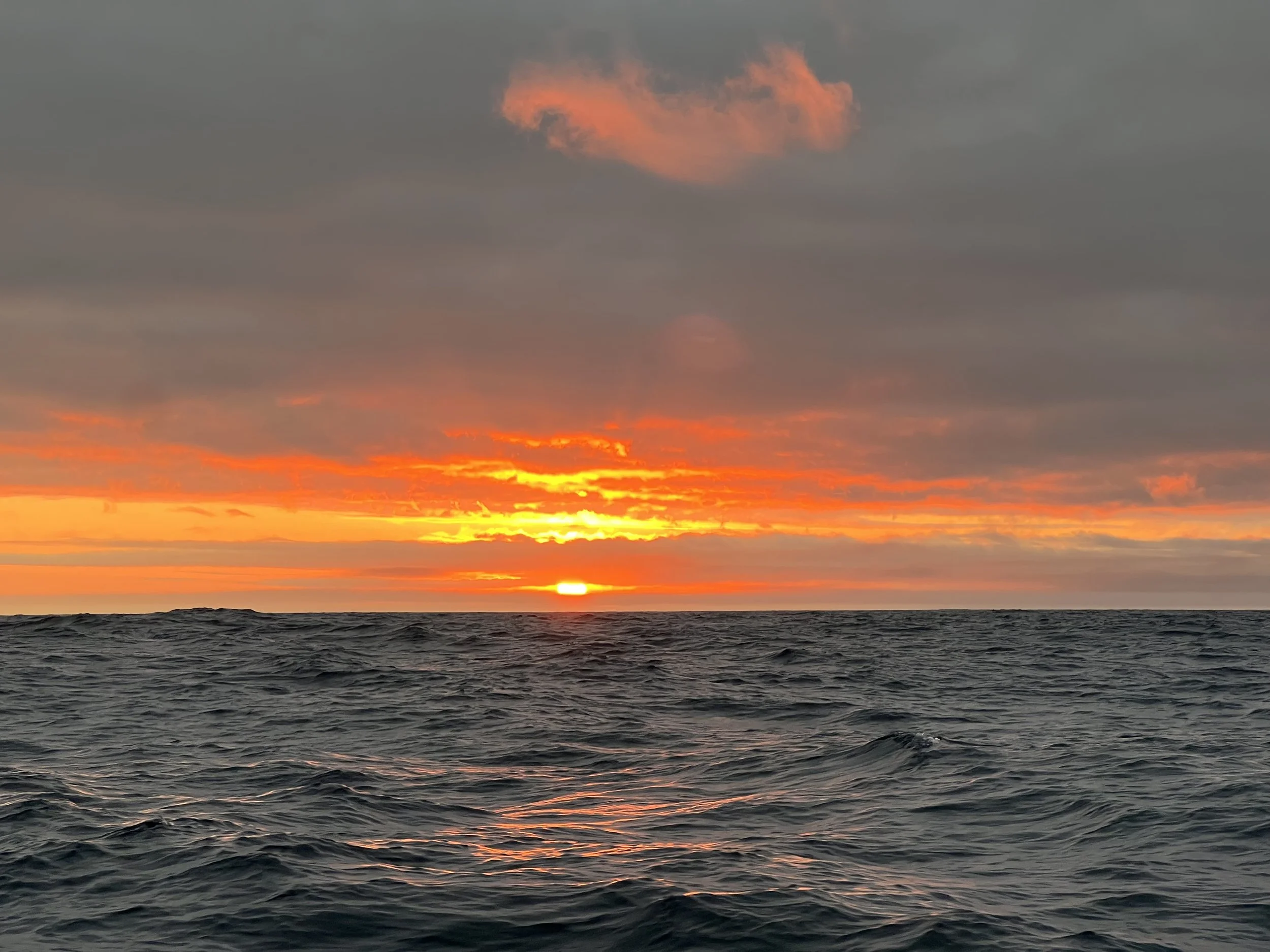
Day 10 July 3-4 2026 44°18.88 N 33° 29.94W, noon to noon 146nm.
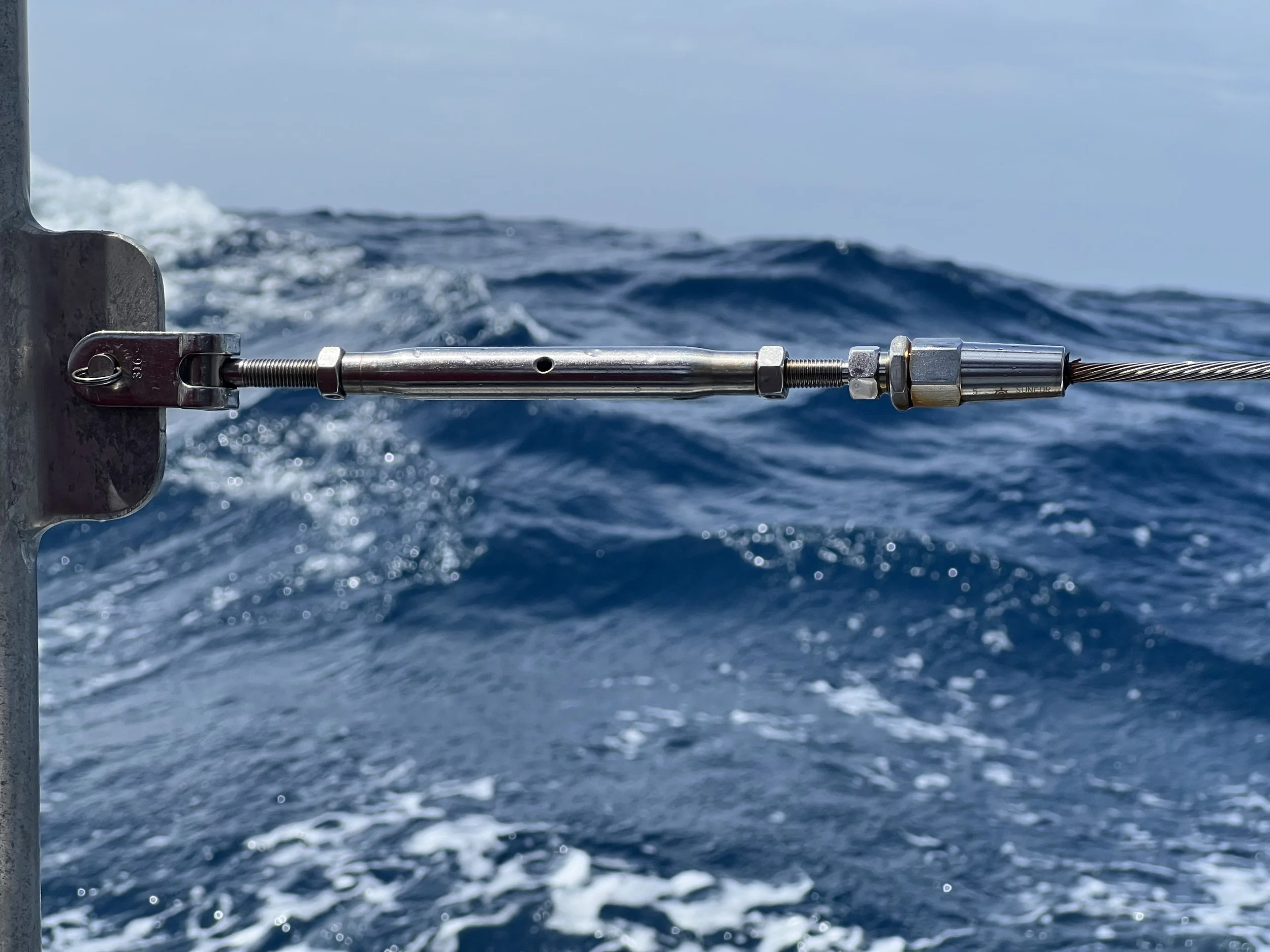
The wind has settled down to a lovely 15-17kt and the rolling swell gently lifts us with only the occasional slew to the side. The sun in the afternoon and reduced waves allow us to finally sit in the cockpit and enjoy the view. We look for whales of course, but no luck. We know this interlude is not going to last forever. Sometime over the next 12-18 hours the wind will go down to about 10kt and veer. We will be wanting a bigger sail to keep us moving in those conditions. Before we retire for the evening, while the conditions are relatively smooth, we go forward and raise the code zero from its resting place in the dinghy. Once in position we take the opportunity to check around to make sure all is ship shape on the forward deck. We look at the turnbuckles and cotter pins . Brian spots the starboard dorade is rather loose. One of the screws holding it in place has sheared off and in all the wave action over the deck it must have worked its way undone. We tighten up the remaining screws, a proper fix will be done in port.
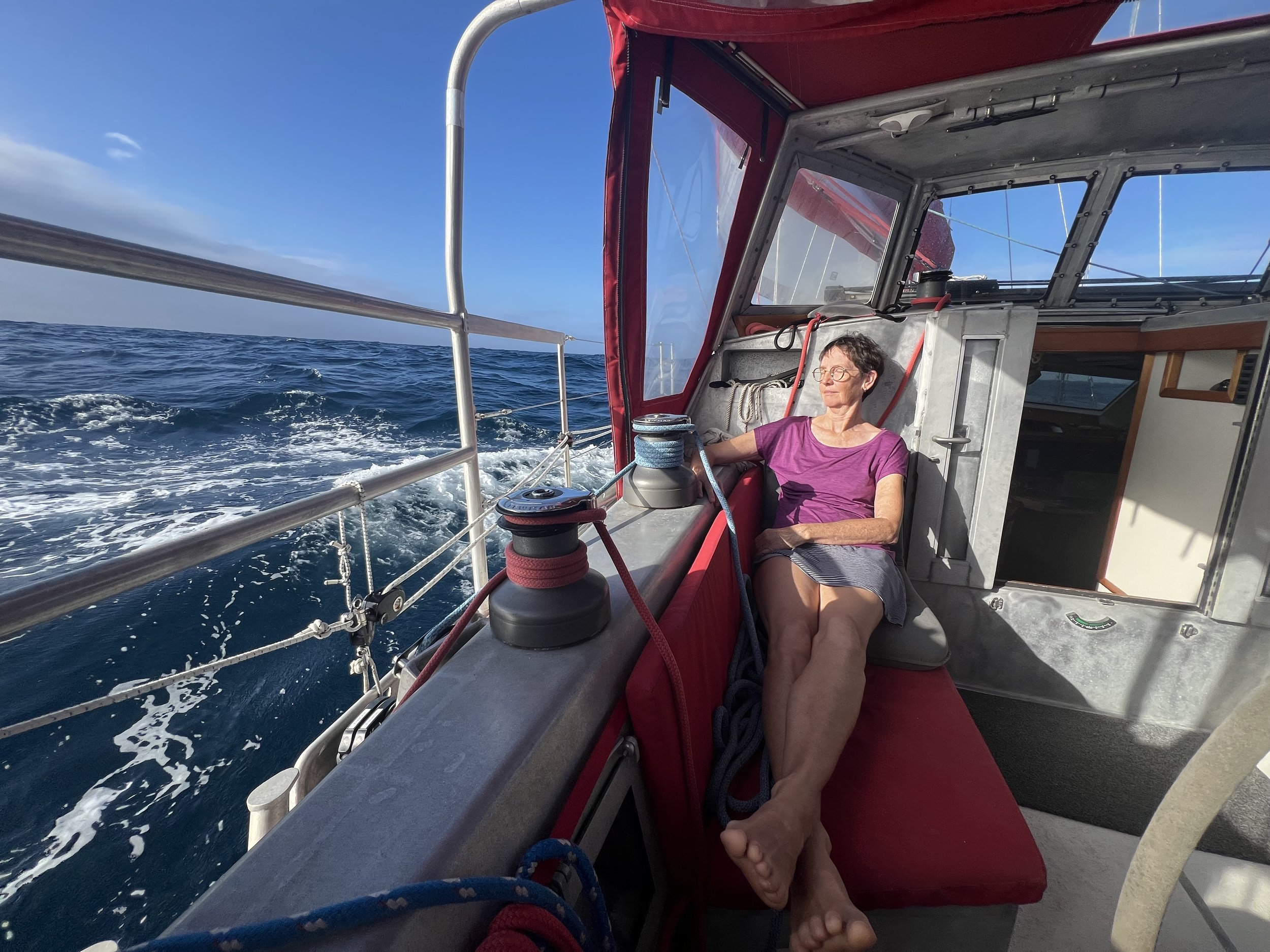
Watching for whales.
Day 11 July 4-5 2026 45° 25.51N 30° 43.87W, noon to noon 145nm.
On cue, the wind fades and we pull out the 88 square meter code zero sail. Our secret weapon, it enables our heavy boat to actually sail in winds of 10-13kt. We continue under code zero and main all afternoon and overnight.
To celebrate Independence Day, we grill some chicken outside with fresh corn and potato salad.
The wind dies in the early hours of the morning and we motor for 3 hours. Perfect timing to charge the battery and make some hot water for showers. We change the ship’s clocks by 2 hours. We will have to repeat another 2 hour time shift on arrival in Ireland.
Day 12 July 5-6 2026 46° 20.96N 27° 53.38W, noon to noon 138nm
The light winds continue and the seas are now rocking us instead of rolling us. We both have some good naps during the afternoon. As we are short handed with just two onboard, staying well rested for long passages such as this one is critical. Our bodies are certainly rested, the lack of exercise is beginning to show with achy hip joints from days of sitting. It is the mental rest that is crucial and needs to be respected. We run a watch system that is very fluid during the day, whoever is in the “watch seat” where you can see the instrument panels at the Nav station in the pilot house salon is on watch. We run the radar as well as chart most all the time, so any untagged vessel or heaven forbid, loose shipping container, might be spotted. The other person might then be free to nap, cook or just relax and read in the cockpit. Night time is different. We have found that a good long deep sleep is most important. Until you are well settled in the journey, getting to sleep is often difficult, with the motion and noises associated with a boat flying through the darkness. When we tried the 3 hour system, we would be nearly asleep before it was time to get up and be on watch. With 5 hours sleep, your sleep cycle is already on the rise when it is time to get up. We do 9pm to 2am, and 2am to 7am. The relieved person (Helen) then has a short 2 hour nap in morning until a joint breakfast starts the day.
We struggle to keep the ship moving, the light winds move a little south, more than forecast making our point of sail a deep broad reach. The code zero flaps every now and then as it loses air due to blanketing by the main. We reef the main to third reef and move it to the center, that gives us 0.5kt more speed. We will take it.
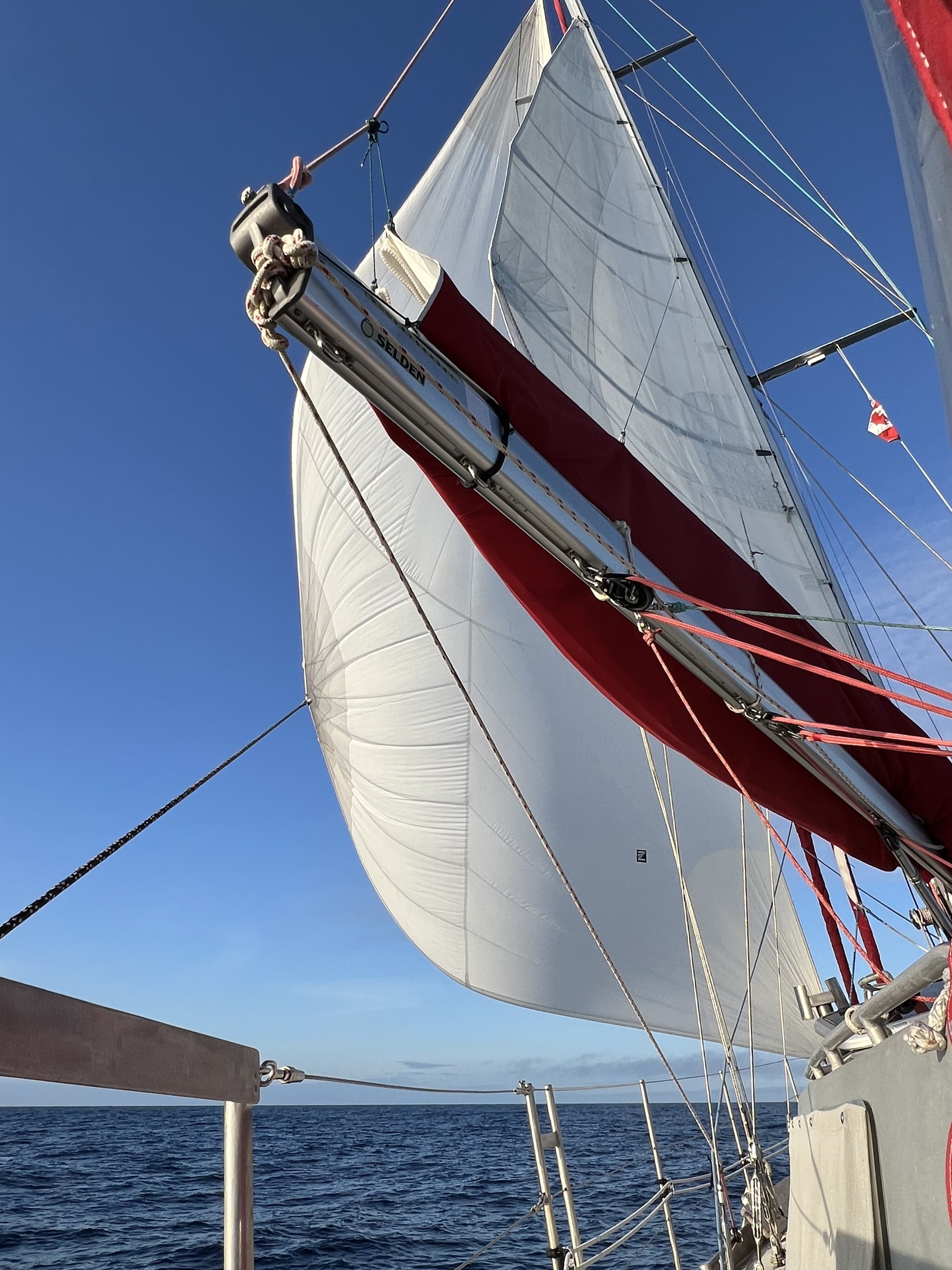
Flying the code zero with main at third reef.
Day 13 July 6-7 2026. 47° 12.16N 24° 37.69W, noon to noon 153nm
I know you are beginning to think how boring this article is getting, just imagine how we are feeling! However, the end is in sight, we have traveled 1897nm and there are approximately 770nm to go. Stay the course.
In reading sailing memoirs, one can put long distance sailors into one of two camps. Those that relish the sailing time alone; the isolation and time to contemplate the power of the ocean, the business of keeping the boat in good repair and the challenge of the varied weather. Then there are those, and I put us firmly in this camp, that sail to get somewhere; passage is something to get through to then be able to enjoy the lands and cultures on the other side. Passages are not something we dread, we embrace the chance to push ourselves beyond our comfort zone and, of course, the anchor dram on arrival is all the sweeter.
The light winds continue, we fly the code zero all day, motoring for a few hours overnight just to keep moving. Our lovely downwind ride all the way to Ireland has now fallen apart and we can see the wind turning contrary for the final 2 days of the passage. We want to keep moving to make the most of the wind while we have it. This is no time to dawdle and be purist about sailing. In the small hours of the morning the code zero comes back out and then it is switched for the genoa. The winds have returned.
We cook sausages and cauliflower cheese, we know it will be a couple of days before real meals can be cooked from scratch again.
Day 14 July 7-8 2026 . 48° 25.32N 20° 33.69W, noon to noon 177nm
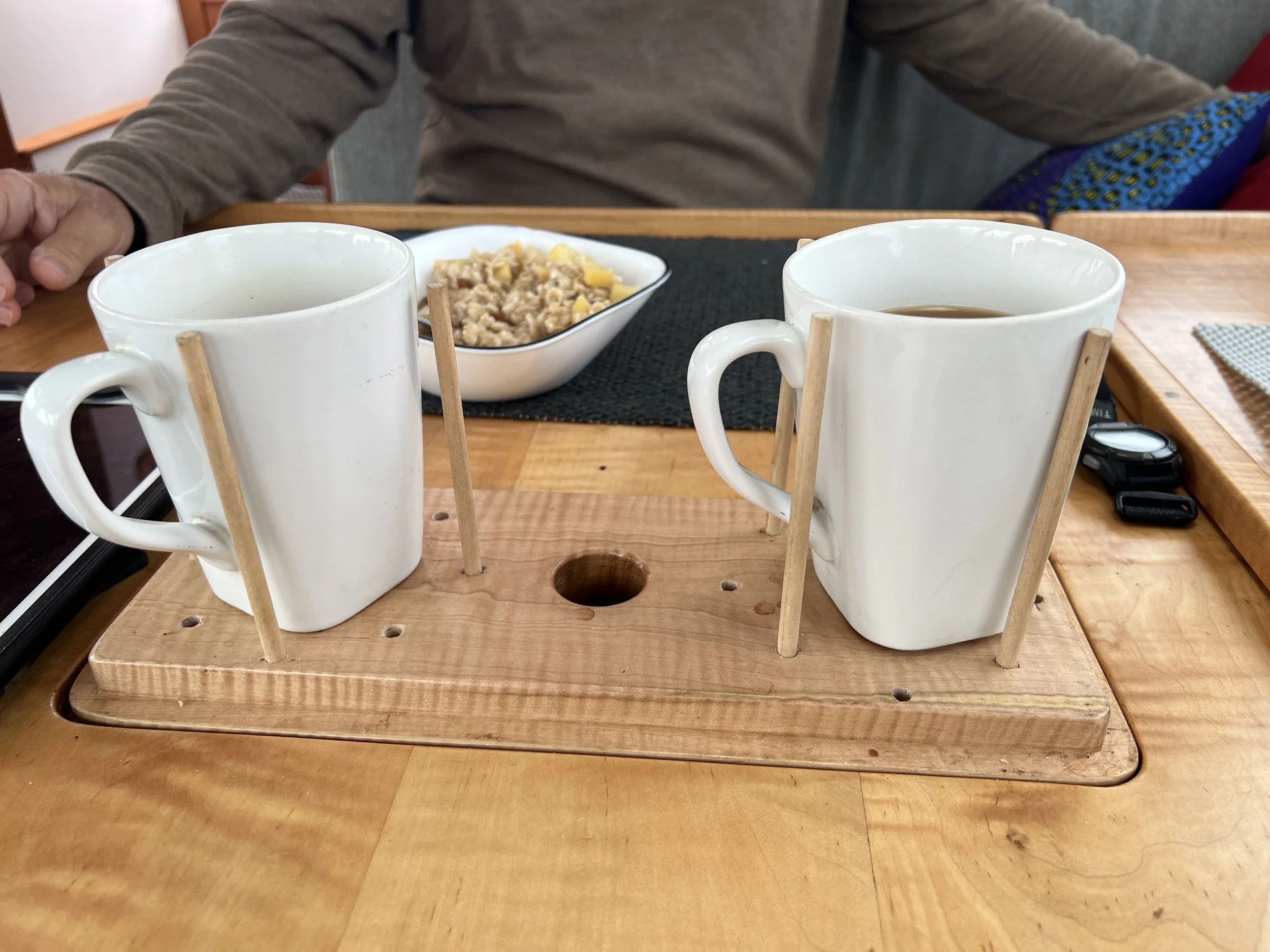
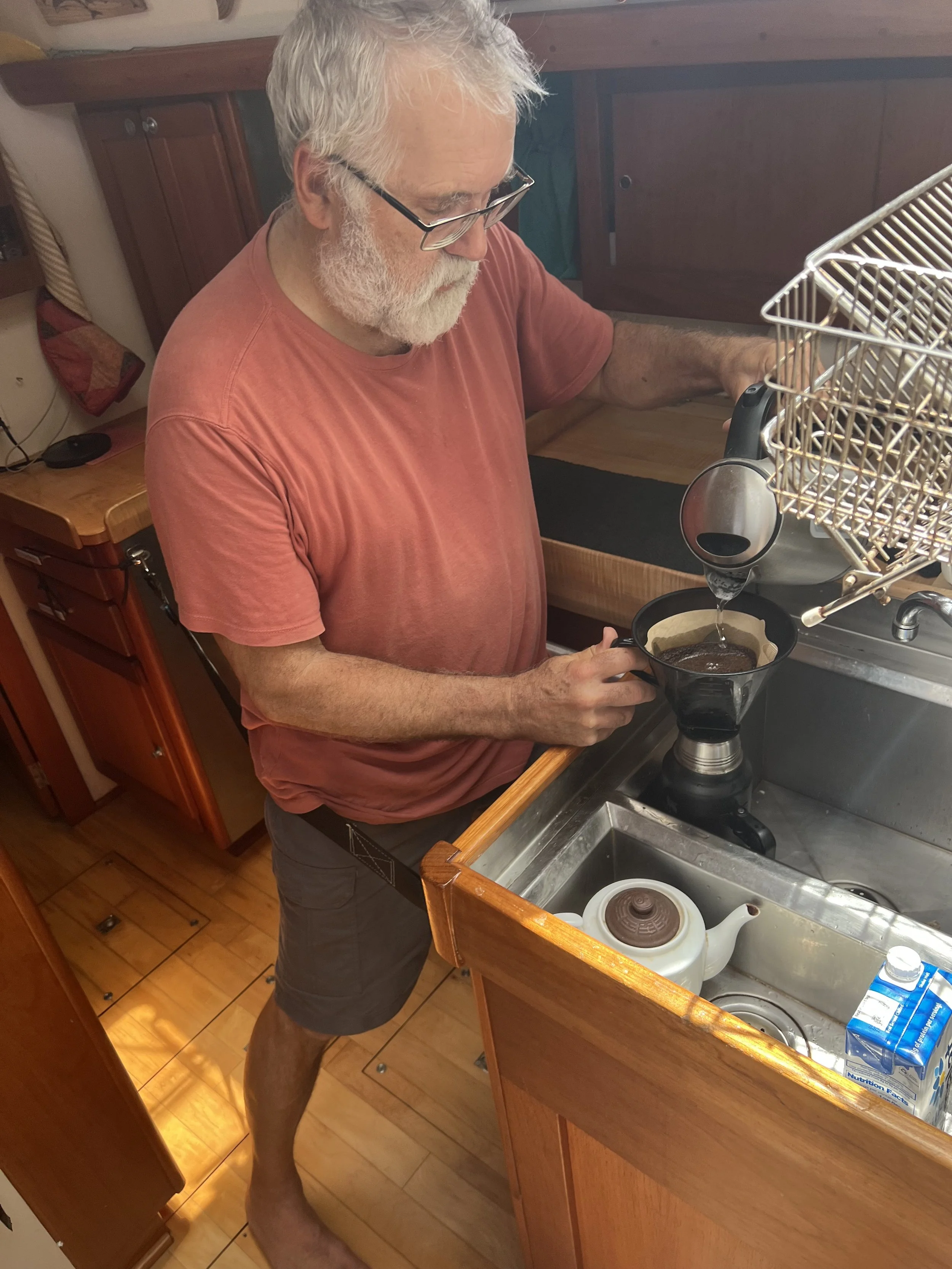
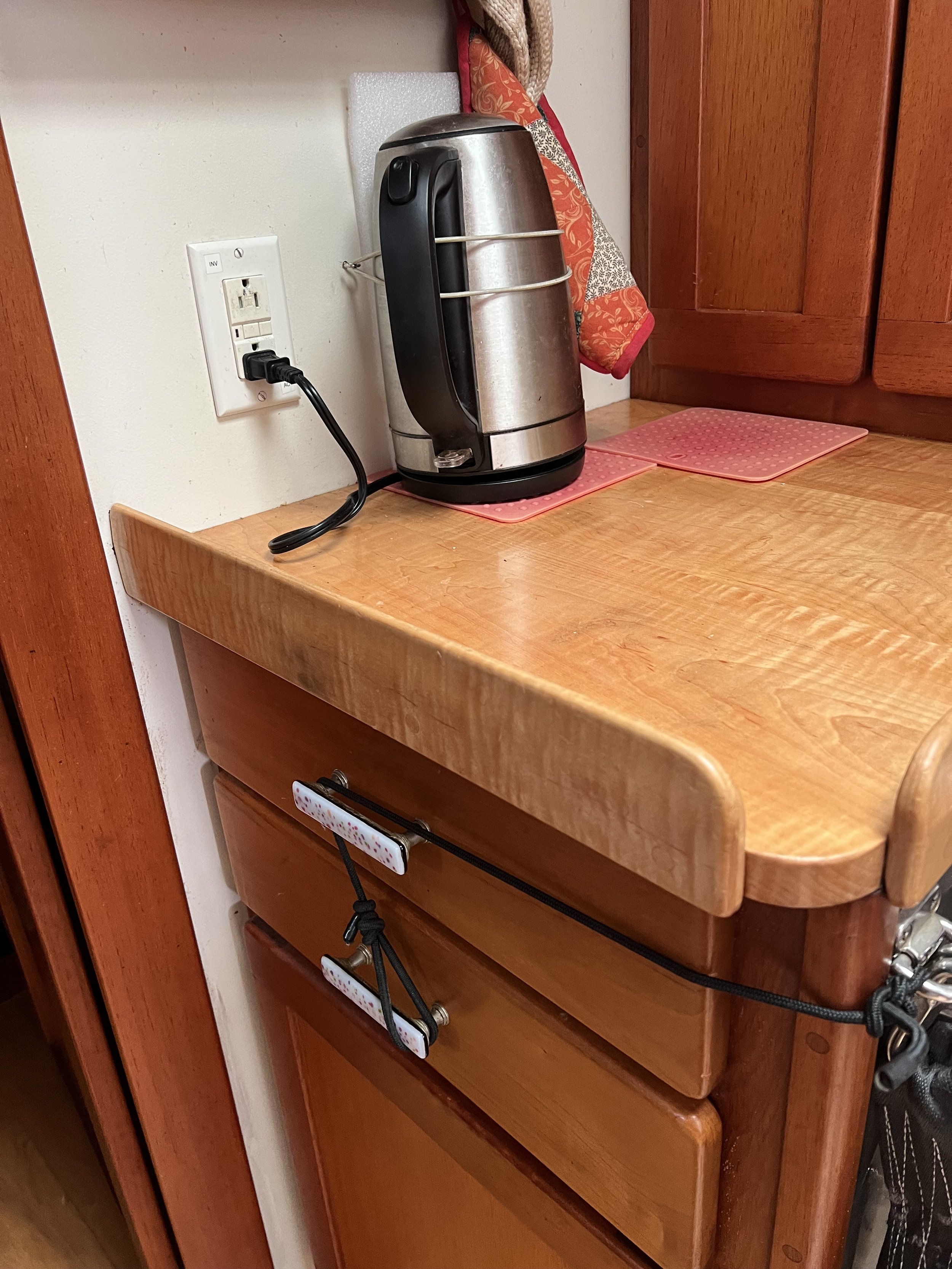
What a ride! A constant 20kt just aft of the beam. We have the main at second reef and partially reefed genoa, the weather helm is 1 degree and we fly along at close to hull speed. This is by far the fastest continuous sailing we have ever done. Day after day of 150nm plus. The seas are still quite large, unsurprisingly, but by now we are barely noticing it as we go about the boat, swinging from handhold to handhold, bracing a hip against a bulwark. There are no longer annoying thumps and bumps from within cupboards, those have all been taken care of with towels or socks. The cutlery drawer is secured with the bungie cord, and the electric kettle is also strapped to the small hooks in the wall. We cook with the galley strap engaged to hold us in position, also while working at the sink. We have our cupholders in the galley and salon table, the center panel where we keep salt and pepper etc can be flipped over and there are holes to put dowels in for keeping the cups in place. Non-skid mats and silicone pads are scattered around to keep those plates and bowls in place.
Chili and rice for dinner with coleslaw.
Day 15 July 8-9 2026, noon to noon 148nm
All afternoon and overnight winds are a steady 17-20kt, another fast 24hours. We did not touch the sails all day and overnight until about 5am when they began to weaken.
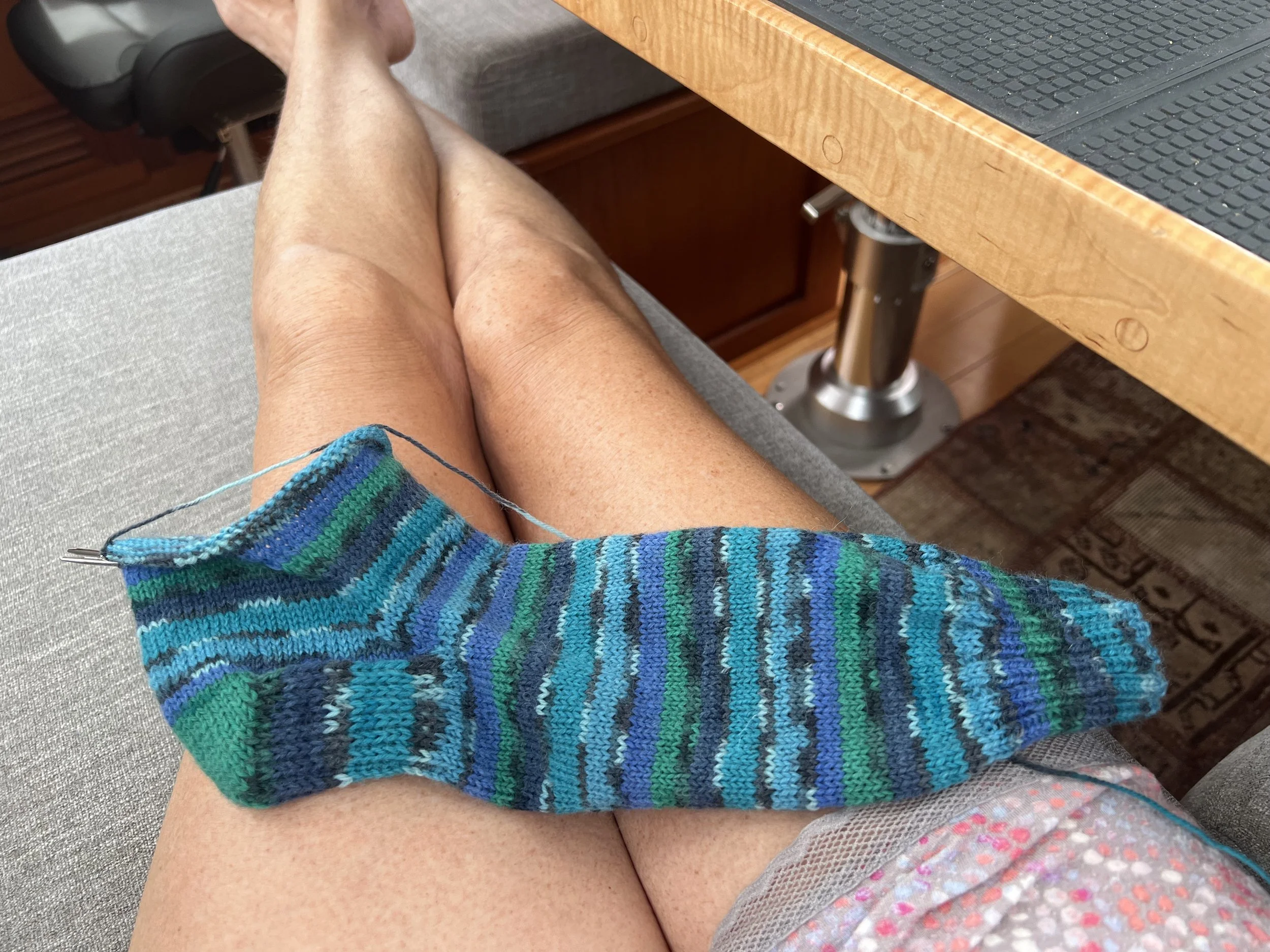
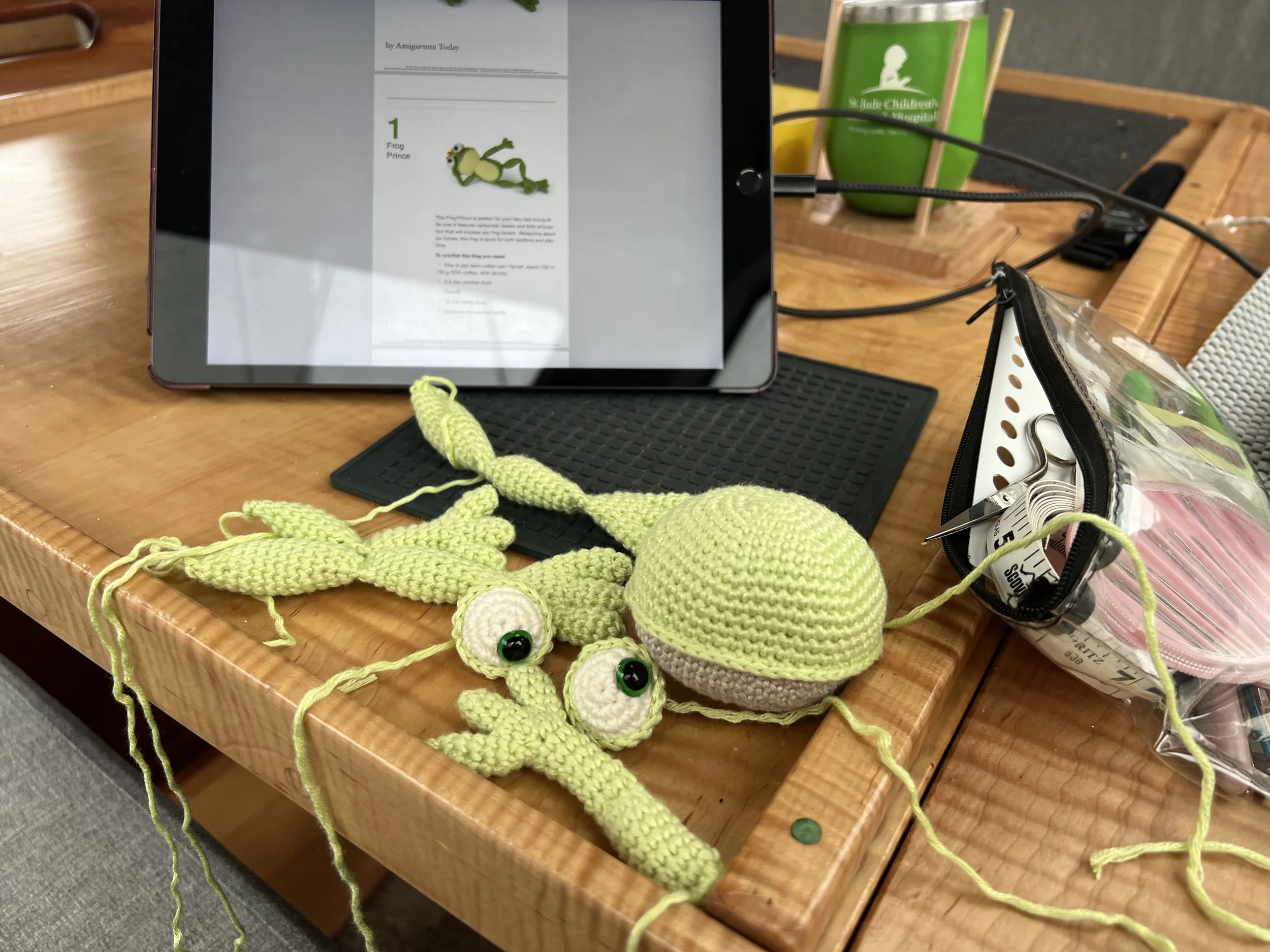
With no sail changes to make, what do we do all day? Well, it pays to have your Kindle stocked up with books. I never read as much as I do on passage. We have a thumb drive with a huge book collection we can select from, and also, thanks to the Starlink, we can use our library cards and download books from our library at home. We also have some card games on the ipad. I like to do handicraft, so a crochet project or knitting some socks passes the time. Brian usually likes to work on processing photos, or writing, but when the boat moves around too much, he is unable to manage the computer work. We have a hard drive filled with movies, a gift from Andreas, a German sailing friend in the Caribbean. It is mostly old classics and TV shows, nothing more current than 10 years ago.
Ravioli with leftover sausage in marinara sauce
Day 16 July 9-10 2026 50° 13.21N 14° 22.79W, noon to noon 124nm
In the morning we pulled out the code zero and sailed in light winds. We are sailing beyond what the weather routing predictions stated. In the late afternoon the engine finally goes on, but we continue with the code zero, motor-sailing in 9kt of wind. The hot water produced by the engine gives us both a chance to have a desperately needed shower. Finally the code zero sail comes down and we pack it away in the dinghy. We do not anticipate needing it again on this trip. Winds are now below 5kt, we motor onwards, a rhumb line to our destination of Bantry Bay.
Steak fajitas for dinner
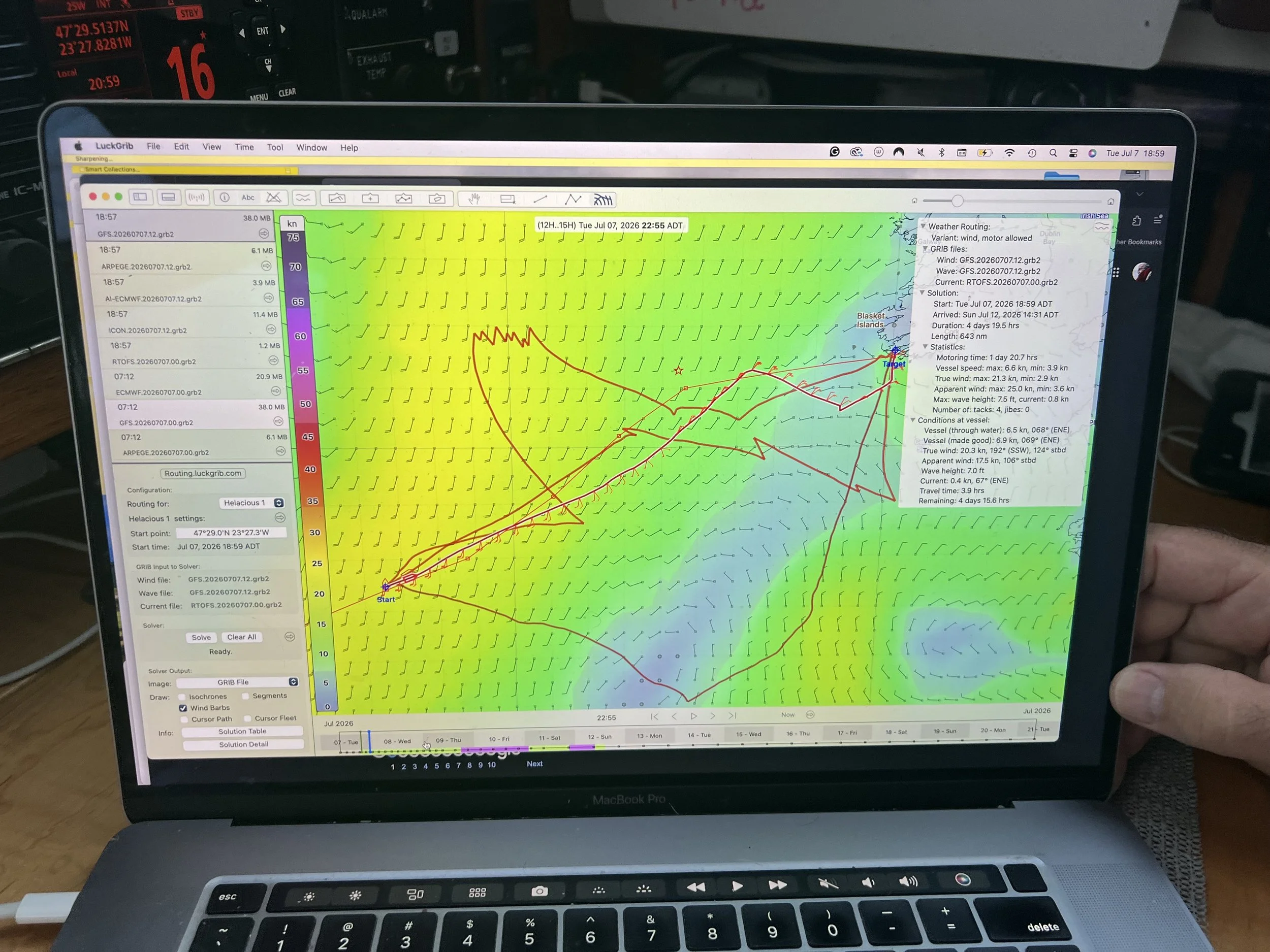
The weather routing algorithm cannot make up its mind. We ended up going rhumb line.
Day 17 July 10-11 2026 noon to noon 106nm
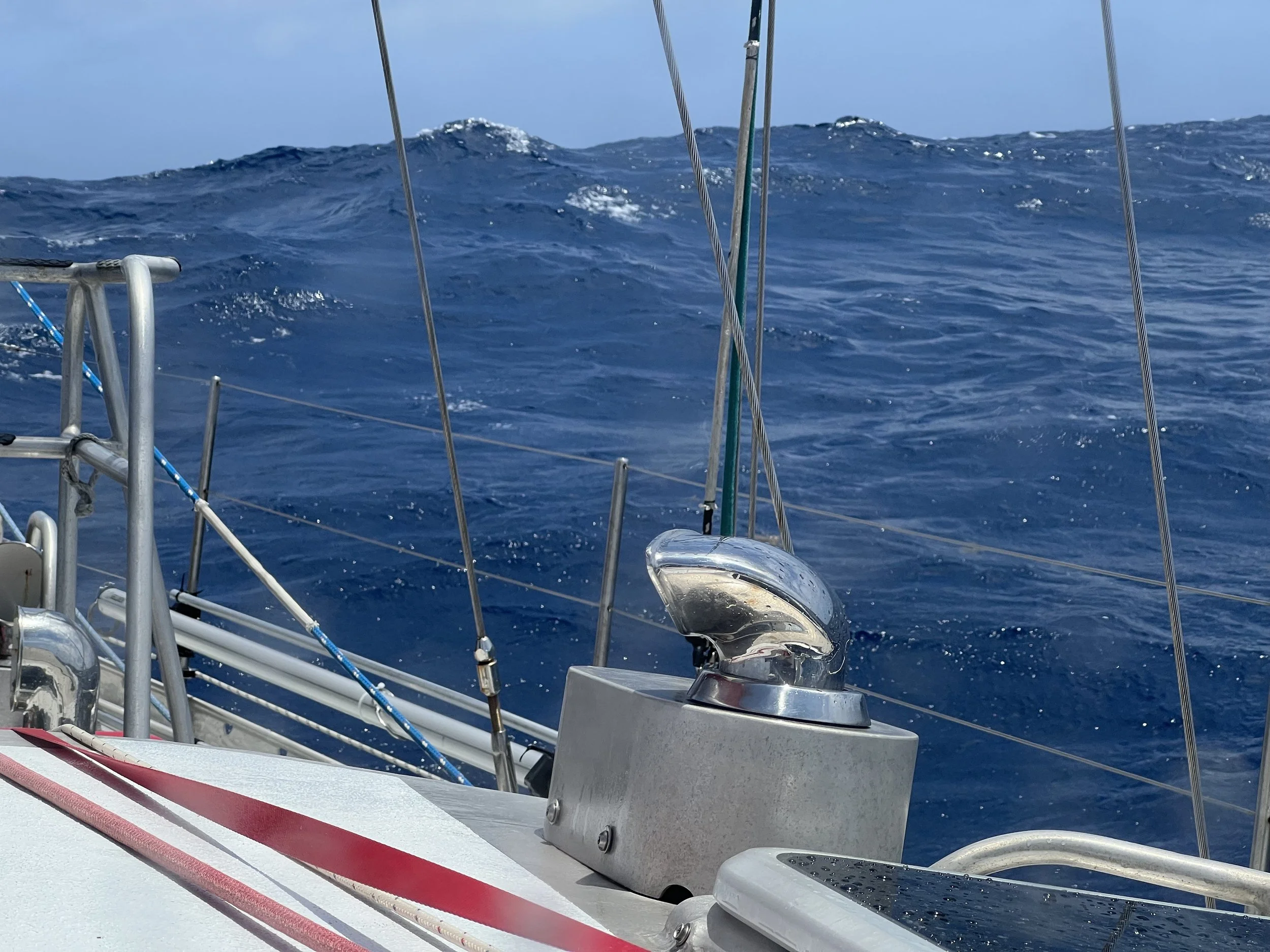
Oh boy, I thought it was rough earlier in this passage. That was nothing. Mid morning the winds return, but instead of the carpet ride of SW winds we have been having all trip, now they are from the NE, the direction we want to go. Over the course of a couple of hours they steadily increase until by 5pm they are holding at 23kt. Now we really feel the strength of the wind as it is forward of the beam, we try to sail but cannot make the angle, we end up veering away from our destination. We turn on the motor and motorsail at a wind angle of 40°. Now we are on a port tack and due to the lurching boat motion (Predict Wind gave a warning for “vertical acceleration” at this point in the passage), we are sitting on the bean bag on the floor or wedged into the quarterberth. We are still not heading to Ireland, more running a course parallel to the south coast, about 70miles south. It is a long night, not much sleep, as the boat lunges from side to side, forward and aft. A bit like a washing machine. We see on the chart this area is called “Porcupine Sea-Bight”, maybe referring to the jagged vertical motion.
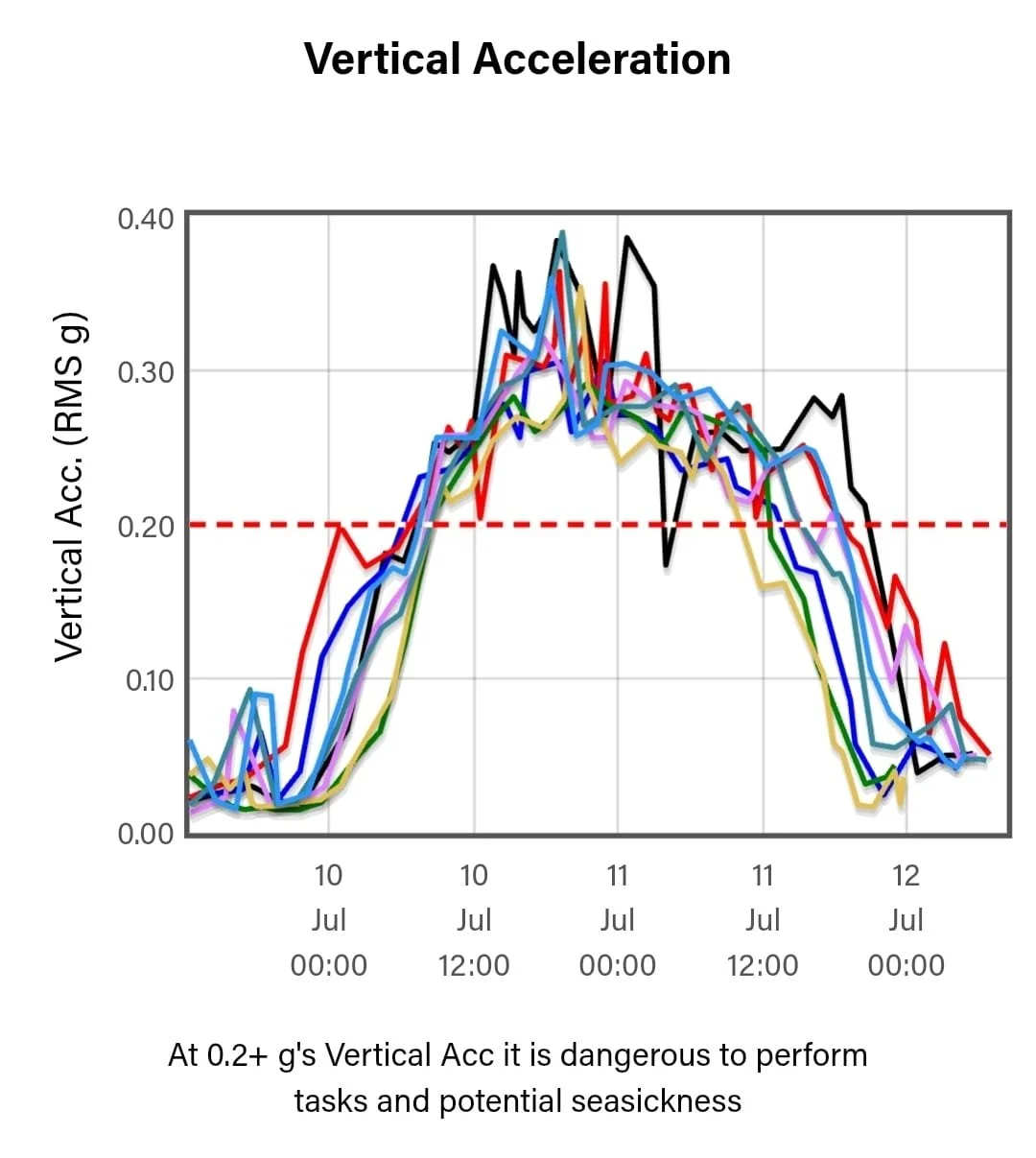
In the morning we pull in the staysail and turn north, almost directly into the wind to try and make it to land. We had considered alternative strategies taking into consideration the forecast over the next few days (steady NE wind in the high teens); maybe sail to Scilly Isles. But that would be a 265nm passage to landfall, then another 165nm return when the winds favorable. Maybe not go quite as far as the Scilly isles, just do a large tack across the south coast of Ireland, but that would also add hundreds of miles to the journey, and we are ready to put our feet on terra firma. So motoring into the wind it is; thank goodness for large fuel tanks.
It is times like this that we really appreciate our sturdy metal boat. We have no middle of the night fears of the keel bolts giving way under the pounding motion of the boat as she falls off the waves. No concern that the joint between the deck and hull might separate or stanchions leak, the welds run continuously all the way around. In fact Helacious is a remarkably dry boat, the bilge pumps have only ever run on two occasions.
We did not eat all day.
Day 18 July 11-12 51° 40.9N 09° 27.72W, noon to noon 105nm
The engine drones on as we motor into the wind, the speed stays below 5kt, fortunately the waves are getting a little smaller so the motion is not so abrupt. It is less than 100nm to go, we can practically taste that Guinness.
At dawn, as the sun is rising, I spot land. We have made it, transatlantic passage #5 in the books. We are grateful and relieved it is over. It turns out, with our southern loop, that this is the longest passage we have ever made, distance-wise. Not the longest in time (that was 22 days crossing from Caribbean to the Azores). In all these passages we have hardly touched the helm. Otto, the Danish autopilot, has taken the load, steering us through monstrous seas and the glassy calms. With just two onboard, the thought of hand steering for days upon days is just unimaginable, I don’t think we could do it. We have spares of course, for this vital piece of equipment, both the drive motor and “brain” of the autopilot. Our steering is top of the line, a Jefa system. No cables and weak connections, it is a planetary gear system with solid linkages joining the system to an auxilliary steering tiller on the rudder shaft. A wind vane would be a nice backup to have, however the geography of the back of the boat, with a swim platform, davits and high cockpit enclosure, preclude us being able to mount one properly.
We arrive Bantry Bay at 12.30pm, exactly 18 days after we left Armdale Yacht Club in Halifax NS. Chrystie and Ken from SV Remedy, friends we met last fall in Annapolis, were waiting and caught our lines from the town dock. It was so good to see friendly and familiar faces. Time to go find that Irish stout and start exploring.
IN SUMMARY:
18 days, 2710nm
Longest distance travelled in 24 hours, 195nm
Fastest speed noted 9.6kt. Average speed on trip 6.7kt.
131 hours motoring.